

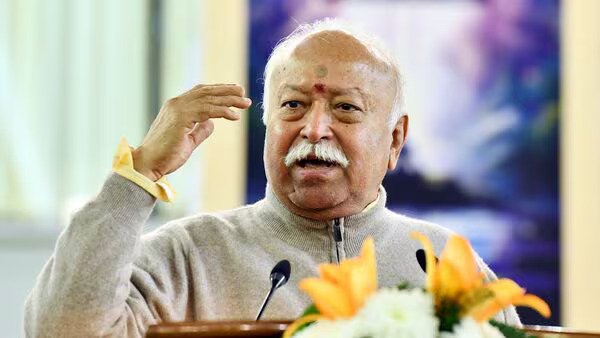
Hindus in a Cultural Shell: Mohan Bhagwat’s Call for Introspection
Paromita Das
GG News Bureau
New Delhi, 7th December- Hindu society has long been marked by its resilience, spirituality, and adaptability in the face of adversity. Yet, this very adaptability has often led to periods of retreat, where the community turns inward, focusing on individual and familial progress rather than asserting itself on broader societal issues. Recently, Rashtriya Swayamsevak Sangh (RSS) chief Mohan Bhagwat issued a clarion call to Hindus to break free from their cultural inertia. His concern centers on the declining population growth among Hindus and its implications for the community’s future within India’s diverse and competitive societal framework.
This statement, rooted in population science and societal analysis, challenges Hindus to examine the broader consequences of their choices. While economic growth and modernization have brought prosperity, they have also fostered compromises that threaten the long-term vitality of Hindu society. Bhagwat’s remarks serve as a wake-up call, urging introspection on issues ranging from demographic trends to cultural values and systemic challenges.
The Declining Share of Hindus in India’s Population
India’s demographic landscape has undergone significant changes since independence. At first glance, the numbers seem reassuring—Hindus grew from 30.3 crore in 1951 to 96.6 crore in 2011. However, the relative share of Hindus in the population has declined from 84.5% to 79.8% over the same period.

Meanwhile, the Muslim population’s share increased from 9.9% to 14.2%, and Christianity, though officially at 2.3%, is estimated by the Pew Research Center to be closer to 2.6%, owing to underreporting among converts.
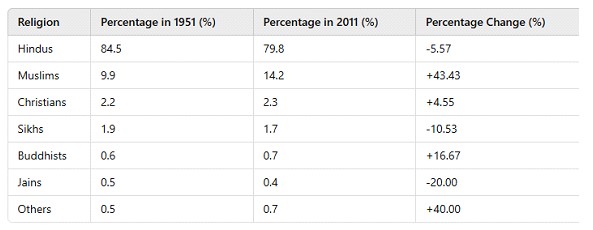
This relative decline in Hindu population share is not merely a statistical concern; it reflects broader social and cultural dynamics. Hindus’ adherence to government campaigns like “Hum Do, Hamare Do” during the 1970s family planning era significantly curtailed their population growth. While this policy was envisioned as a means to ensure better quality of life, it has inadvertently left Hindus with a declining growth rate compared to other communities.
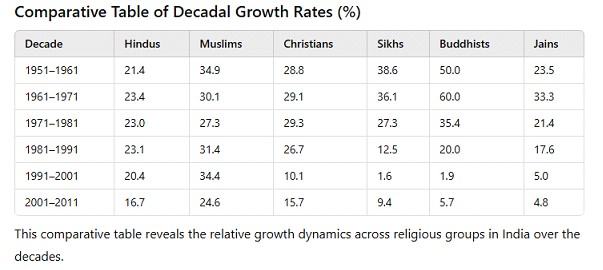
Bhagwat’s invocation of the 2.1 replacement fertility rate—a threshold below which a population declines—underscores the urgency of the issue. While other communities have continued to grow at higher decadal rates, Hindus have maintained a lower growth rate in the 20s, compared to Muslims whose decadal growth has often hovered in the 30s. Over decades, these compounded differences have led to a noticeable shift in population dynamics.
Cultural and Economic Choices: A Double-Edged Sword
The decline in Hindu population share cannot be viewed in isolation from the cultural and economic shifts that have reshaped society over the last few decades. The slogan “Hum Do, Hamare Do” encapsulates the economic logic of smaller families: fewer children meant more resources for education, healthcare, and housing. While this strategy appeared practical at the time, its long-term cultural consequences were largely overlooked.
The pursuit of economic stability came at the cost of traditional family structures and cultural values. Rising real-estate prices, expensive education, and costly medical care have made family planning decisions increasingly constrained by financial pressures. Furthermore, the rising cost of food, often adulterated and nutritionally inadequate, has compounded health and fertility issues, creating additional barriers to having larger families.
The broader societal shift towards urbanization and modernity also placed new expectations on Hindu women, urging them to prioritize careers over family responsibilities. While this movement was framed as women’s empowerment, it failed to emphasize the need for balance. The result has been a growing trend of women opting out of family life altogether, exacerbating the already declining birth rate among Hindus.
Historical Context: Survival Against All Odds
The Hindu community’s history is one of extraordinary survival. Despite centuries of invasions, looting, and forced conversions, Hindus have managed to preserve their cultural and spiritual identity. Economically, the community has weathered significant upheavals without losing its entrepreneurial spirit. Yet, this resilience is being tested in new ways.
Unlike past challenges, which were external in nature, the current crisis stems from within. The willingness to compromise for the sake of economic progress, coupled with systemic inefficiencies in governance, has placed Hindus in a precarious position. The wealth accumulated in temples—many of which are controlled by state governments—stands as a stark reminder of the community’s inability to assert control over its own resources. This lack of autonomy further limits the community’s ability to address the challenges of education, healthcare, and cultural preservation.
The Role of Governance and Policy
Bhagwat’s statement is not just a call to individuals but also an implicit challenge to policymakers. Structural issues such as the high cost of education, unaffordable housing, and inadequate healthcare cannot be solved by individual effort alone. Government intervention is necessary to regulate these sectors and ensure that the benefits of economic growth are shared equitably.
Adulteration in food, for instance, is a critical issue that affects public health and fertility. Similarly, the rising cost of education limits access to quality learning for many families, forcing them to make difficult choices about family size. Real-estate speculation and the lack of affordable housing further constrain young couples from expanding their families. Unless these systemic issues are addressed, the cultural call to have larger families will remain unheeded.
A Time for Cultural and Political Reawakening
Bhagwat’s remarks touch a nerve in a society grappling with its identity in a rapidly changing world. The Hindu community must recognize that its demographic trends have far-reaching implications for its cultural, political, and social influence. However, the solution lies not in fear-mongering but in a balanced approach that combines individual responsibility with systemic reforms.
A cultural reawakening is needed to emphasize the value of family and community life, alongside economic pursuits. At the same time, the government must step in to alleviate the structural barriers that discourage larger families. Policies aimed at reducing the cost of living, improving access to quality education, and ensuring food safety will play a crucial role in reversing the current trends.
Conclusion: The Shift from “Hum Do” to a Sustainable Future
Mohan Bhagwat’s warning about the declining Hindu population is both a wake-up call and a reminder of the community’s historical resilience. Hindus must take stock of their cultural and demographic realities, balancing the pursuit of modernity with the preservation of their traditions and values.
The Overton window has shifted from “Hum Do, Hamare Do” to a new debate: “Jiski Jitni Abadi, Uski Utni Hissedari” (one’s population determines one’s share). If Hindus are to navigate this transition successfully, they must prioritize both individual and collective efforts. Only by addressing systemic barriers and fostering a renewed sense of cultural purpose can the community secure its future in an increasingly competitive and diverse India.
The post Hindus in a Cultural Shell: Mohan Bhagwat’s Call for Introspection appeared first on Global Governance News- Asia's First Bilingual News portal for Global News and Updates.