

Paromita Das
GG News Bureau
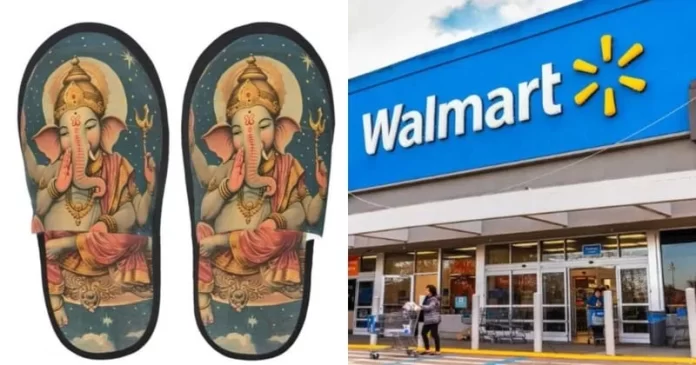
New Delhi, 10th December- The American multinational retail corporation Walmart has recently come under fire for its insensitivity toward Hindu sentiments. The uproar began after it was discovered that Walmart had been selling a range of products under its “Celestial Ganesh Blessings Collections,” including footwear, underwear, and swimsuits, embossed with the sacred image of Lord Ganesha, one of the most revered deities in Hinduism. The revelation sparked outrage among the global Hindu community, who deemed it a blatant act of disrespect and cultural appropriation.
The Incident and Outrage
The controversy was first brought to light by a user on X (formerly Twitter), who highlighted the offensive use of Hindu religious imagery on inappropriate products such as boxers, thongs, and flip-flops.
A well-known X (formerly Twitter) user, ‘Tathvam-asi (@ssaratht),’ highlighted how the American multinational retail corporation was disrespecting Hindu sentiments. He tweeted, “This is unacceptable. You can’t demean our Hindu Gods.”
This is unacceptable. You can’t demean our Hindu Gods.@Walmart should immediately withdraw ‘Celestial Ganesh Blessings collection’ and apologise to Hindus.
pic.twitter.com/KGCcqqObXu
— Tathvam-asi (@ssaratht) December 6, 2024
The images shared by the user revealed Walmart’s catalog of at least 70 variants of clothing and accessories featuring the image of Lord Ganesha. The user, along with others on social media, criticized Walmart for “demeaning Hindu Gods” and trivializing religious symbols.
Hindu advocacy organizations and activists were quick to condemn Walmart’s actions. Prominent Hindu activist Rajam Zed emphasized the sanctity of religious symbols, stating that “Symbols of any faith, larger or smaller, should not be mishandled.” Organizations such as the Hindu Jagruti and Hindu American Foundation (HAF) also raised objections, pointing out the cultural and spiritual significance of Lord Ganesha in Hinduism. The organizations demanded the removal of the products and a formal apology from Walmart.
Socks and women underwear are removed.
Links for the remaining ones are herehttps://t.co/Ao254Ld9Sxhttps://t.co/2mjU2T6hMehttps://t.co/TYpeGb8u8shttps://t.co/DzDlknM7ayhttps://t.co/be8h6vnKoi pic.twitter.com/G53RMT0KbO
— Tathvam-asi (@ssaratht) December 6, 2024
Amid mounting pressure from social media users and advocacy groups, Walmart removed most of the products from its shelves. However, it was noted that some swimsuits featuring the deity’s image were still being sold, raising questions about the company’s commitment to respecting cultural sensitivities.
The Hindu advocacy group ‘Insight UK’ expressed its outrage in a tweet, stating, “The Hindu community is extremely concerned about this. It reflects blatant negligence and a complete lack of respect for Hindu Gods, sentiments, and sensibilities.”
Hindus worldwide are outraged at Walmart's negligence on selling products featuring Hindu sacred deity Ganesha.
Lord Ganesha, a highly revered Hindu god, is featured on products like slippers and knickers that @Walmart is selling.
Hindu community is extremely concerned about… pic.twitter.com/m6JEZfbp9Q
— INSIGHT UK (@INSIGHTUK2) December 6, 2024
The Hindu Jagruti organization stated, “Depicting Shri Ganesh, a highly revered Hindu deity, on items like underwear, boxers, socks, and slippers is deeply offensive and disrespectful to Hindus worldwide.” The group also demanded a formal apology from Walmart.
Dear @walmarthelp: @HinduAmerican has written directly to @Walmart regarding the disrespectful misuse of Hindu imagery on slippers & bathing suits.
Ganesha is a deity worshipped by more than a billion followers of Dharma religions around the world as the remover of obstacles.… pic.twitter.com/WHrpFOYPQU
— Hindu American Foundation (@HinduAmerican) December 6, 2024
The Larger Issue of Hinduphobia in Corporate Spaces
This incident is not an isolated case but part of a larger pattern of cultural insensitivity and Hinduphobia exhibited by global corporations. Over the years, several companies have engaged in similar practices, sparking outrage among Hindus worldwide.
In April 2022, the swimwear brand Sahara Ray Swim faced backlash for printing images of Hindu deities on bikinis. Owned by a surfer-turned-model, the brand was accused of exploiting sacred symbols for profit while disregarding the religious significance of those images.
In 2019, Amazon courted controversy for selling floor mats and toilet seat covers featuring images of Hindu gods, including Lord Shiva and Goddess Kali. The outrage from Hindus led to the removal of these products, but not before irreparable harm was caused to religious sentiments.
Another incident occurred in 2018, when a nightclub in Bushwick, New York, decorated its walls with paintings of Hindu deities. The establishment faced criticism for treating Hindu religious icons as mere decorative art, stripping them of their sacred context.
Why This Matters
The repeated misuse of Hindu religious symbols highlights a broader issue of cultural ignorance and appropriation in the West. Hinduism, one of the oldest religions in the world, emphasizes reverence for its deities and sacred symbols. Lord Ganesha, in particular, is considered a remover of obstacles and a harbinger of wisdom and prosperity. His image is not merely decorative but carries profound spiritual significance for millions of Hindus worldwide.
By placing such sacred imagery on products like underwear and slippers, companies trivialize deeply held beliefs, reducing spiritual icons to mere commodities. This not only disrespects Hindu culture but also perpetuates a broader pattern of disregard for non-Western religious traditions.
The Role of Advocacy and Social Media
One of the most striking aspects of this controversy is the role of social media in holding corporations accountable. Platforms like X and organizations such as the Hindu American Foundation have emerged as powerful tools for amplifying voices and addressing grievances. In this case, social media outrage played a significant role in pressuring Walmart to remove the offensive items from its inventory.
Hindu advocacy groups have also been instrumental in demanding accountability from corporations. Their persistent efforts have forced companies to acknowledge their mistakes, remove offensive products, and issue apologies. However, the recurrence of such incidents suggests that more needs to be done to educate corporations about cultural sensitivity and respect for religious diversity.
Conclusion: A Need for Corporate Responsibility
The Walmart controversy serves as a sobering reminder of the need for cultural sensitivity and corporate responsibility in a globalized world. While Walmart has taken steps to address the outrage, the incident underscores a deeper issue of ignorance and insensitivity toward Hindu culture.
As corporations continue to expand into diverse markets, they must recognize the importance of respecting the beliefs and traditions of the communities they serve. This requires more than reactive measures; it demands proactive efforts to understand and honor cultural diversity.
The repeated misuse of Hindu symbols in commercial ventures reveals a glaring gap in cultural awareness. To bridge this gap, corporations must invest in education and engage with advocacy groups to ensure their products and practices align with the values of the communities they impact. Only by fostering a culture of respect and inclusivity can they avoid controversies like this and build lasting relationships with their global customer base.
In a world increasingly interconnected by commerce and culture, respect for diversity is not just an ethical imperative but a business necessity. Walmart and other corporations must learn from this incident and take concrete steps to prevent such oversights in the future. Only then can they hope to truly embody the values of inclusivity and mutual respect that are essential in today’s globalized world.
The post Walmart’s Use of Lord Ganesha’s Imagery Sparks Global Outrage Among Hindus appeared first on Global Governance News- Asia's First Bilingual News portal for Global News and Updates.