

Paromita Das
GG News Bureau
New Delhi, 11th Dec. The Indian National Congress, once synonymous with Bharat’s struggle for independence, finds itself mired in controversy again as allegations of foreign influence cast a shadow over its operations. The ruling Bharatiya Janata Party (BJP) has launched a scathing attack, alleging the Congress’s links to foreign powers and organizations that have a history of interfering in stable democracies and pushing agendas that challenge Bharat’s sovereignty. Central to this latest uproar is the association between the Congress party, its leaders, and the George Soros Foundation—a connection that has raised questions about foreign funding in Bharatiya politics and its implications for national security.
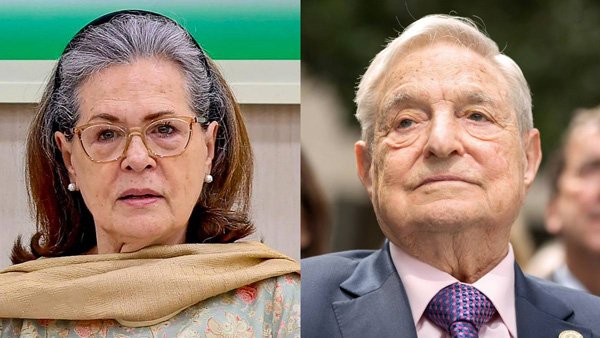
On December 8, the BJP took to social media to accuse Sonia Gandhi, the former Congress President, of having ties to George Soros, a controversial Hungarian-American billionaire notorious for his alleged role in destabilizing democracies. The BJP’s allegations center on Gandhi’s role as co-president of the Forum of Democratic Leaders in Asia-Pacific (FDL-AP), an organization reportedly financed by Soros’s foundation. The BJP claims FDL-AP has historically supported the idea of Kashmir as an independent entity, a position that directly undermines Bharat’s territorial integrity.
Adding fuel to the fire, the BJP also alleged that the Rajiv Gandhi Foundation (RGF), chaired by Sonia Gandhi, received funds from the George Soros Foundation. These claims were supported by images of Salil Shetty, Vice President of the Soros-funded Open Society Foundation, participating in Rahul Gandhi’s Bharat Jodo Yatra—a moment BJP argued reflected Congress’s closeness to Soros-linked entities. The ruling party also cited Shashi Tharoor’s public acknowledgment of Soros as an “old friend” as further evidence of deep-rooted connections.
The controversy deepened with revelations about the Organised Crime and Corruption Reporting Project (OCCRP), an investigative body known for its exposés on corporate and political corruption. The BJP pointed to a live telecast of Rahul Gandhi’s press conference on the Adani Group by OCCRP, implying a coordinated effort to tarnish Bharatiya businesses and institutions. These claims gained momentum following a report by the French newspaper Mediapart, which revealed that OCCRP receives nearly half its funding from U.S. government agencies such as the Department of State and USAID. According to the investigative report, OCCRP’s structural dependence on U.S. institutions undermines its claims of being an independent organization.
The allegations against Congress do not stop at Soros or U.S.-linked organizations. The BJP has also highlighted Congress’s connections with China, particularly during its tenure in the United Progressive Alliance (UPA) government. In 2008, Congress signed a Memorandum of Understanding (MoU) with the Communist Party of China (CPC), paving the way for high-level exchanges and consultations on regional and international issues. This agreement resurfaced as a contentious issue during the 2017 Doklam standoff, when Rahul Gandhi was photographed meeting Chinese officials at a time of heightened tensions between Bharat and China. Further revelations about the Rajiv Gandhi Foundation receiving over ₹1 crore from the Chinese government between 2006 and 2020 have only added to the suspicions surrounding Congress’s foreign connections.
These allegations have ignited fierce debate across Bharat, with the BJP accusing Congress of compromising national interests for political and financial gains. According to the BJP, the Congress’s ties to foreign organizations reflect a dangerous trend of undermining Bharatiya sovereignty for ideological and monetary gains. On the other hand, Congress leaders have dismissed these allegations as baseless and politically motivated, claiming that the BJP is attempting to divert attention from pressing governance failures.
At the heart of this controversy lies a broader question about the role of foreign funding and influence in Bharatiya politics. While no political party is entirely free of external interactions, the claims against Congress raise legitimate concerns about the extent to which foreign entities, particularly those with questionable agendas, can sway domestic political narratives. George Soros, for instance, is a polarizing figure globally, with critics accusing him of destabilizing democracies under the guise of promoting liberal values. His foundation’s reported involvement in supporting narratives that challenge Bharat’s sovereignty, such as treating Kashmir as an independent entity, has sparked fears about foreign meddling in Bharat’s internal affairs.
The Congress’s alleged links with China further complicate its position, especially at a time when Bharat-China relations remain fraught. The MoU with the Communist Party of China and financial contributions from Chinese entities to the Rajiv Gandhi Foundation suggest a level of engagement that raises red flags. Critics argue that such ties undermine Bharat’s strategic posture and compromise its ability to address Chinese aggression decisively.
In conclusion, the allegations against Congress underscore the need for greater transparency and accountability in political funding and foreign associations. While the BJP’s accusations may serve its immediate political agenda, they also point to a larger issue of ensuring that Bharatiya political parties remain insulated from external influences that could jeopardize national interests. For Congress, this controversy represents yet another challenge to its credibility at a time when the party is striving to revive its political fortunes. Without addressing these allegations convincingly, the Congress risks alienating a public increasingly wary of foreign interference in Bharat’s democratic processes. In the end, safeguarding Bharat’s sovereignty must remain a non-negotiable priority for all political actors, regardless of ideological differences.
The post Congress Under Fire: Alleged Ties to George Soros and China Spark Fierce Debate appeared first on Global Governance News- Asia's First Bilingual News portal for Global News and Updates.