

Paromita Das
GG News Bureau
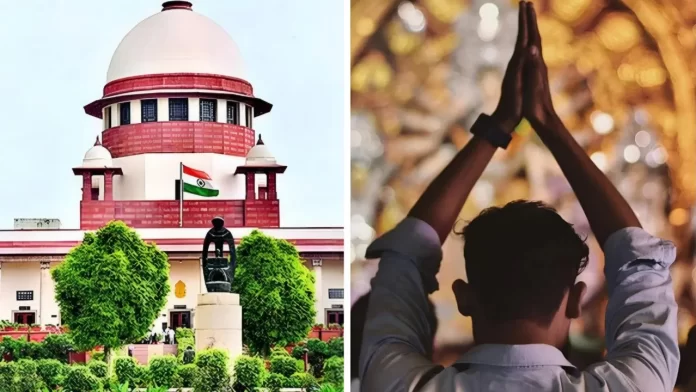
New Delhi, 20th Dec. The Supreme Court’s interim order on December 12, staying all legal proceedings and surveys under the Places of Worship Act, 1991, has ignited a storm of legal and constitutional debates. While the decision ostensibly seeks to maintain public order and communal harmony, it raises significant concerns about judicial overreach, constitutional rights, and the rule of law. The move has far-reaching implications for how Bharat addresses historical grievances, balances societal tensions, and protects individual rights.
The Controversy: A Blanket Stay on Pending and Future Suits
The bench, led by Chief Justice Sanjiv Khanna and comprising Justices P.V. Sanjay Kumar and K.V. Viswanathan, issued a blanket stay on all cases concerning the Places of Worship Act, 1991. This includes halting litigation and surveys aimed at reclaiming or determining the religious character of disputed sites. While the directive comes as part of the ongoing judicial scrutiny of the Act’s constitutional validity, its sweeping nature has raised eyebrows. Without concrete data on the number of affected cases, the decision appears to lean more on political and societal pressures than a coherent legal rationale.
Legal and Constitutional Concerns
At the heart of the controversy lies the Places of Worship Act, enacted in 1991 to preserve the religious character of all places of worship as they stood on August 15, 1947, except for the Ayodhya dispute. The legislation was a political compromise designed to quell communal tensions, but critics argue that it suppresses legitimate grievances and denies individuals the constitutional right to judicial review.
Judicial review, as established in landmark cases like Minerva Mills Ltd. vs. Union of India (1980), is a fundamental right and an essential component of the Constitution’s basic structure. By staying all related legal proceedings, the Supreme Court’s interim order inadvertently endorses the very denial of judicial review that petitioners have challenged. This creates a paradox where the judiciary itself limits access to justice, potentially undermining its role as the guardian of constitutional rights.
Ayodhya Verdict and the Ambiguities of Obiter Dicta
The Supreme Court relied on observations from the 2019 Ayodhya verdict to justify its intervention, citing the Constitution bench’s commentary on the Places of Worship Act. However, these observations were obiter dicta—statements made in passing without binding authority. The Ayodhya bench did not adjudicate the Act’s constitutionality, raising questions about whether such commentary can serve as the basis for a nationwide freeze on legal proceedings.
This reliance on tangential observations instead of substantive legal principles underscores the judicial adventurism evident in the interim order. The Court’s approach reflects an increasing tendency to prioritize societal stability over the rigorous application of the rule of law, a trend fraught with long-term consequences.
Balancing Harmony and Justice
The Court’s stated objective of maintaining peace and harmony is undoubtedly laudable, particularly given the communal sensitivities surrounding disputed religious sites. Chief Justice Khanna’s emphasis on avoiding violence, as seen in his remarks during the Sambhal case, aligns with the judiciary’s responsibility to uphold public order. However, prioritizing temporary calm over addressing underlying grievances risks creating a facade of harmony while leaving deeper issues unresolved.
True societal reconciliation demands a lawful and constitutional resolution of disputes. Suppressing legal claims in the name of harmony only emboldens those who leverage the threat of violence to shape judicial outcomes. The interim order sends a troubling message: that the rule of law can be subordinated to the fear of unrest, undermining the judiciary’s credibility and independence.
Political and Historical Context
The Places of Worship Act itself is a product of political compromise. Enacted by the P.V. Narasimha Rao-led Congress government, it sought to freeze the status quo of religious sites while exempting the Ayodhya dispute, which was already a flashpoint. Critics argue that this approach stifles historical grievances and imposes a one-size-fits-all solution on complex, context-specific disputes.
Adding to the controversy is the differing interpretation of the Act by previous Supreme Court benches. In May 2022, a three-judge bench led by then-Chief Justice D.Y. Chandrachud noted that the Act does not bar the ascertainment of the religious character of places of worship. This nuanced stance was met with criticism from certain quarters, highlighting the polarized views on how the Act should be implemented.
Judicial Independence Under Pressure
The Supreme Court’s interim order has emboldened sections of the political and intellectual elite that support the Places of Worship Act, while silencing dissenting voices. Former Chief Justice Chandrachud, who took a balanced view during the Gyanvapi case, has faced undue criticism from pressure groups. This reflects a broader challenge to judicial independence, not just from the government but also from societal factions that seek to influence judicial outcomes.
As former CJI Chandrachud aptly noted, judicial independence extends beyond freedom from government interference. It requires protection from the pressures of interest groups and public opinion, ensuring that justice is not only done but also seen to be done. The interim order, however, raises concerns about the judiciary’s susceptibility to external influences.
The Precedent and Its Implications
The Supreme Court’s decision sets a precarious precedent that may have far-reaching consequences. By halting all related legal proceedings, the judiciary risks creating a chilling effect on the exercise of constitutional rights. Individuals and groups seeking redress for historical grievances may feel disillusioned, while the perception that violence can dictate judicial outcomes undermines faith in the rule of law.
This approach also paradoxically strengthens the criticism of the Places of Worship Act itself, which is accused of suppressing dissent through legislative fiat. By lending judicial imprimatur to the Act without addressing its constitutionality, the Court inadvertently validates these criticisms.
Conclusion: A Crossroads for Constitutional Governance
The Supreme Court’s interim order in the Places of Worship Act case raises critical questions about the balance between maintaining peace and upholding justice. While the intent to preserve communal harmony is commendable, the method employed risks undermining constitutional principles and judicial independence.
By prioritizing temporary stability over a deeper resolution of historical grievances, the judiciary has set a troubling precedent. True reconciliation requires addressing the root causes of discontent through lawful, transparent, and constitutional mechanisms. Anything less risks eroding public trust in the judiciary and the broader framework of constitutional governance.
As the nation awaits the Supreme Court’s final verdict on the Places of Worship Act, the judiciary must tread carefully. The principles of justice, equity, and rule of law must guide its decisions, ensuring that short-term peace does not come at the cost of long-term justice.
The post Places of Worship Act: Supreme Court’s Interim Order Raises Questions of Justice and Judicial Overreach appeared first on Global Governance News- Asia's First Bilingual News portal for Global News and Updates.