

Paromita Das
GG News Bureau
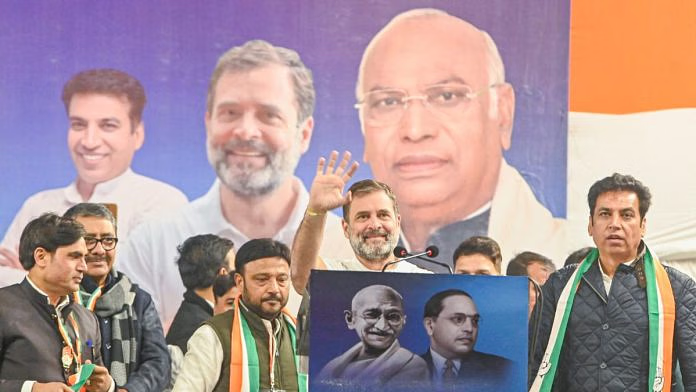
New Delhi, 14th Jan. The Seelampur constituency in Northeast Delhi has become the focal point of Congress’s electoral strategy as the party gears up for the Delhi Assembly elections. By choosing this Muslim-dominated constituency to launch its campaign, Congress, led by Rahul Gandhi, is banking on its age-old formula of minority appeasement and vote bank politics. The rally, titled “Jai Bhim, Jai Samvidhan,” signals Congress’s intent to secure both the Muslim and Dalit votes while positioning itself as the custodian of social justice and constitutional values.
जय बापू, जय भीम, जय संविधान!
देश के जननायक, नेता विपक्ष आदरणीय श्री @RahulGandhi जी कल सीलमपुर में विशाल जनसभा को संबोधित करेंगे।#DelhiWithJannayak#CongressHaiZaroori pic.twitter.com/B4EHIllHx5
— Delhi Congress (@INCDelhi) January 12, 2025
However, this move comes with its fair share of controversy and political maneuvering, reflecting Congress’s desperation to regain its lost foothold in the capital. With Seelampur’s communally sensitive history and its significance as a key constituency bridging multiple regions of Delhi, Congress’s strategy underscores the high stakes of the upcoming elections.
Seelampur: A Constituency Steeped in Communal and Political Complexities
Seelampur holds immense political and strategic importance. With a voter base comprising 55-60% Muslims, the constituency has often served as a battleground for parties vying for the minority vote. Historically a Congress stronghold, the constituency has shifted towards the Aam Aadmi Party (AAP) in recent years, with the party winning the last two assembly elections.
The region’s communal sensitivities have also made it a hotspot for political opportunism. Seelampur was one of the epicenters of the anti-CAA protests in 2020, which saw widespread violence and arson led by Muslim mobs. The involvement of key political figures, including Abdul Rehman—now Congress’s candidate—underscores the deep-rooted communal and political dynamics at play.
Congress’s “Bheem-Meem” Strategy
By launching its campaign in Seelampur, Congress aims to consolidate the “Bheem-Meem” vote bank, a strategy that seeks to unite Dalits and Muslims under its banner. The “Jai Bhim, Jai Samvidhan” rally is designed to appeal to both communities, leveraging recent controversies like Union Home Minister Amit Shah’s comments on Dr. B.R. Ambedkar to position Congress as the defender of Dalit rights.
At the same time, Congress is doubling down on its Muslim outreach. The decision to field Abdul Rehman, a former AAP MLA accused of inciting violence during the anti-CAA protests, signals the party’s willingness to overlook controversy in favor of electoral gain. This calculated move reflects Congress’s intent to challenge AAP and BJP for dominance in Muslim-majority areas.
The Shadow of the Anti-CAA Protests
Seelampur’s recent history is inseparable from the anti-CAA protests, which brought the constituency into the national spotlight. The protests, initially framed as a response to the Citizenship Amendment Act, quickly escalated into violence, with mobs attacking public property, clashing with police, and inciting communal tensions.
Abdul Rehman, Congress’s candidate for Seelampur, was named in an FIR for allegedly provoking crowds during these protests. His involvement has raised questions about Congress’s commitment to law and order and its willingness to field candidates with controversial pasts. Critics argue that this move undermines the party’s claim to uphold constitutional values, as it appears to prioritize vote bank politics over principles.
Political Realignments and the Quest for Muslim Votes
Seelampur is also witnessing significant political realignments. Former Congress stalwart Chaudhary Mateen Ahmed, who previously held sway over the constituency, has joined AAP, with his son Jubair Ahmed contesting on an AAP ticket. Meanwhile, Abdul Rehman, who was denied a ticket by AAP, has switched allegiance to Congress.
This reshuffling highlights the intense competition for Muslim votes in Seelampur. Congress’s focus on this constituency reflects its broader strategy to reclaim its position as the primary alternative to BJP, particularly among minority communities. However, the party faces stiff competition from AAP, which has established itself as a formidable force in Delhi politics.
Congress’s Muslim Appeasement: A Controversial Legacy
Congress’s reliance on minority appeasement is not new. The party has long been accused of prioritizing Muslim votes through symbolic gestures and policy decisions. In Seelampur, this strategy is evident in its choice of rally location, candidate selection, and narrative framing.
However, this approach has also drawn criticism for its divisive impact on communal harmony. By focusing exclusively on minority appeasement, Congress risks alienating other voter groups and reinforcing stereotypes about its inability to represent all sections of society.
A Double-Edged Sword for Congress
Congress’s decision to launch its campaign in Seelampur is a calculated gamble. On one hand, it underscores the party’s determination to reclaim its traditional vote bank and challenge AAP’s dominance. On the other hand, it exposes Congress to accusations of pandering to communal sentiments and overlooking the broader issues facing Delhi voters.
Fielding a candidate like Abdul Rehman, who carries the baggage of the anti-CAA protests, is a risky move that could backfire. While it may consolidate Muslim votes in the short term, it also opens the party to criticism from opponents and alienates voters seeking stability and governance.
Conclusion: The Road Ahead for Congress
As the Delhi Assembly elections approach, Congress faces an uphill battle to reclaim its lost relevance. Its strategy in Seelampur reflects a broader attempt to reassert its identity as a champion of minority and marginalized communities.
However, the party must tread carefully. Overreliance on appeasement politics risks overshadowing its message of governance, development, and social justice. To succeed, Congress must balance its focus on vote banks with a commitment to addressing the diverse concerns of Delhi’s electorate.
The Seelampur campaign is a microcosm of Congress’s challenges and opportunities in the capital. Whether the “Bheem-Meem” strategy can deliver results remains to be seen, but it is clear that the stakes for Congress—and for the people of Delhi—are higher than ever.
The post Congress’s Seelampur Gamble: Vote Bank Politics and the Struggle for Relevance appeared first on Global Governance News- Asia's First Bilingual News portal for Global News and Updates.