

Paromita Das
New Delhi: For decades, Western media, international organizations, and political institutions have demonstrated a clear bias in their portrayal of Bharat. Despite being the world’s largest democracy, a fast-growing economy, and a civilizational powerhouse, Bharat is often depicted through a lens of negativity, selective outrage, and misrepresentation. While developed nations commit serious human rights violations, exploit weaker economies, and engage in military interventions worldwide, Bharat is frequently lectured, scrutinized, and targeted for internal matters that are often exaggerated or misrepresented.
The recent controversy surrounding the United Nations Human Rights Chief Volker Turk’s remarks on Kashmir and Manipur is another example of this Western double standard. Instead of addressing real human rights crises in their own backyard, the West continues its outdated colonial-era habit of judging Bharat through a skewed, self-righteous perspective.
Bharat’s Strong Response to UNHRC Chief’s Baseless Allegations
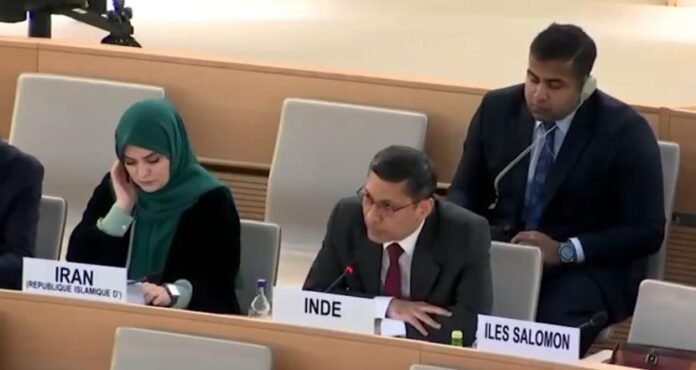
On Monday, March 4, 2024, Bharat issued a strong diplomatic response to United Nations Human Rights Chief Volker Turk, who made unwarranted remarks about the situation in Kashmir and Manipur during the 58th session of the UN Human Rights Council in Geneva.
Turk arbitrarily demanded that Bharat “step up efforts” to manage violence and displacement in Manipur and criticized the Bharatiya government for restricting civic space in Kashmir. His statements completely ignored ground realities, failed to acknowledge Bharat’s efforts in handling these issues, and conveniently overlooked far worse human rights violations in the West and their allied nations.
In a stern diplomatic response, Arindam Bagchi, India’s Permanent Representative to the UN, took Turk to task for his selective outrage and misleading statements.
Bagchi asserted:
“As India was mentioned by name, let me begin by emphasizing that the world’s largest democracy continues to be a healthy, vibrant, and pluralistic society. Unfounded and baseless comments in the update contrast jarringly with ground realities.”
Bagchi further criticized the UNHRC Chief for using loose terminology and cherry-picking issues while remaining silent on glaring human rights violations elsewhere.
VIDEO | 58th regular session of the Human Rights Council: Here's what India's permanent representative to the United Nations in Geneva, Arindam Bagchi said reacting to UN human rights chief Volker Turk's remarks on Kashmir, Manipur.
"As India was mentioned by name, let me begin… pic.twitter.com/xlnoJvxydb
— Press Trust of India (@PTI_News) March 3, 2025
“The High Commissioner has sensed a pervasive unease, but we would submit that a key element to addressing this is a long and hard look in the mirror by the Office of the High Commissioner,” Bagchi stated, directly calling out the West’s hypocrisy in selectively targeting Bharat.
Western Hypocrisy: Ignoring Their Own Human Rights Abuses
While the West eagerly points fingers at Bharat, it deliberately ignores its own atrocities, human rights violations, and political failures.
- United States: Continues to have one of the highest rates of police brutality, racial discrimination, and mass surveillance. War crimes in Iraq, Afghanistan, and Syria remain unpunished, and human rights violations in Guantanamo Bay continue.
- United Kingdom: Still struggles with institutional racism, rampant Islamophobia, and harsh immigration policies targeting refugees.
- France: Suppresses religious freedoms, particularly against Muslim minorities, while preaching liberty and human rights.
- Germany and the EU: Have faced severe backlash over their discriminatory treatment of migrants and asylum seekers.
- NATO’s War Crimes: From the destruction of Libya to the ongoing Ukraine crisis, Western nations have a long history of instigating wars, toppling governments, and exploiting weaker nations for their own geopolitical gains.
Despite these severe human rights violations, the Western media and international organizations rarely hold their own governments accountable. Instead, they conveniently shift focus to countries like Bharat, Russia, and China to maintain a false moral superiority.
The West’s Obsession with Kashmir: A One-Sided Narrative
Kashmir has long been used by Western organizations and biased think tanks as a tool to discredit Bharat. While terrorism and separatism fueled by Pakistan continue to be major concerns, Western nations rarely acknowledge Bharat’s counterterrorism efforts or the progress made in the region.
Turk’s statement about restrictive laws and harassment of journalists in Kashmir completely ignored:
- The role of Pakistan in sponsoring terrorism in Kashmir.
- The improvement in law and order since the abrogation of Article 370.
- The fact that Kashmiri Pandits were victims of ethnic cleansing and remain ignored by international human rights bodies.
The Western media’s bias is evident in the way they never question Pakistan’s treatment of minorities, Balochistan’s human rights violations, or China’s crackdown on Uyghur Muslims, yet constantly raise alarm over Bharat’s internal matters.
Western Interference in Bharat’s Domestic Affairs
The West’s selective criticism of Bharat is not just about human rights—it is about maintaining geopolitical influence. Bharat’s rise as an economic powerhouse, military strength, and independent foreign policy has unsettled Western elites, who still view non-Western nations through a colonial lens.
Whenever Bharat takes firm action to protect its sovereignty, the Western media and policymakers cry foul.
- When Bharat stands up against Chinese aggression, it is labeled as escalatory.
- When Bharat refuses to bow down to Western narratives on Russia, it is called diplomatically defiant.
- When Bharat cracks down on extremist elements, it is accused of suppressing democracy.
These double standards expose how the West uses human rights rhetoric as a political tool, rather than a genuine concern for global justice.
Bharat Must Reject Western Lectures
It is high time that Bharat stops entertaining Western hypocrisy and asserts its own narrative on the global stage. Bharat must:
- Challenge biased reporting by Western media outlets that spread misinformation.
- Expose Western nations’ double standards at international forums like the UN, G20, and BRICS.
- Continue building strong diplomatic alliances with Global South nations, African partners, and BRICS countries to counter Western dominance.
- Strengthen its independent foreign policy, refusing to align with Western geopolitical games.
The era of Western superiority is fading. Bharat, with its economic rise, cultural resurgence, and diplomatic assertiveness, is reshaping the global order. The days when the West could unilaterally dictate narratives to Bharat are over.
Conclusion: The West Must Look in the Mirror
The West’s obsession with portraying Bharat in a negative light is not just a reflection of bias—it is a desperate attempt to cling to fading global influence. By selectively criticizing Bharat while ignoring their own human rights failures, Western institutions like the UNHRC expose their lack of credibility and hidden political motives.
Bharat’s response to Volker Turk’s remarks on Kashmir and Manipur sends a strong message—Bharat will not tolerate interference, misinformation, or selective outrage. The world is changing, and Bharat is no longer a passive observer—it is a global force to be reckoned with.
The West must accept Bharat’s rise as a sovereign power and abandon outdated colonial mindsets. Instead of lecturing Bharat, the West should fix its own problems and look in the mirror, as Bharat’s representative Arindam Bagchi rightly pointed out.
The post The West’s Bias Against Bharat: A Flawed Narrative of Misinformation appeared first on Global Governance News- Asia's First Bilingual News portal for Global News and Updates.