

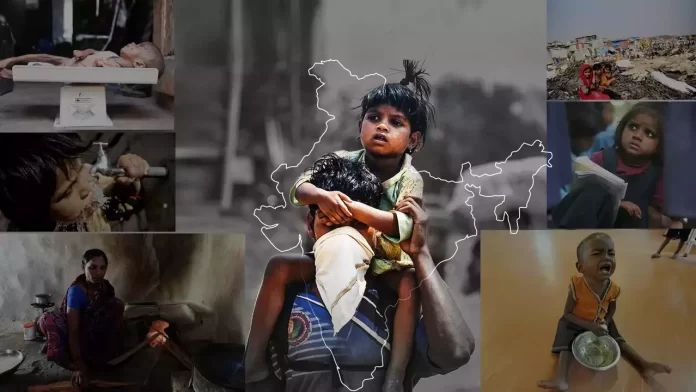
Paromita Das
New Delhi: For decades, poverty reduction in Bharat has been a subject of intense debate, with varying estimates and political narratives shaping public perception. However, a recent study by economists Surjit S. Bhalla and Karan Bhasin, titled “Four Facts on Inclusive Growth in Bharat,” has presented groundbreaking insights into Bharat’s poverty trends.
Using data from the Household Consumption Expenditure Survey (HCES) for 2022-23 and 2023-24, the study reveals that Bharat has successfully eradicated extreme poverty, marking one of the most significant economic achievements in modern history. This finding challenges long-standing criticisms of income inequality and calls for a complete re-evaluation of how poverty is measured in Bharat.
According to the study, extreme poverty in Bharat has fallen below 1% in 2023-24, a sharp contrast to 12.2% in 2011-12. Even using the World Bank’s 1.9 and 2.15 PPP (Purchasing Power Parity) dollar poverty lines, the data confirms a dramatic reduction, highlighting Bharat’s inclusive economic growth over the past decade.
Extreme Poverty Eradicated: A Historic Achievement
One of the most remarkable revelations of the study is that Bharat’s extreme poverty rate has nearly reached zero. The report states that in 2011-12, 12.2% of Bharat’s population was living in extreme poverty, but by 2023-24, this figure had fallen below 1%.
This decline is unprecedented for a country of Bharat’s size and economic diversity. Unlike many high-growth economies that experience rising income disparity, Bharat’s growth has been largely inclusive, benefiting the lowest income groups at a substantial rate.
The study highlights that the Gini coefficient, a measure of income inequality, has declined from 37.5 in 2011-12 to 29.1 in 2023-24. This contradicts the widely held belief that economic liberalization and rapid GDP growth have only benefited the rich while widening the gap between the wealthy and the poor.
Consumption Growth Among the Poor: A Testament to Inclusive Policies
Another key finding in the study is the sharp rise in consumption among the poorest segments of society. The bottom 30% of Bharat’s population has seen their monthly per capita expenditure rise by 11.9%, with spending on food increasing by 10.7% and on durable goods like appliances and furniture increasing by 24.2%.
This increase in consumption reflects improved financial stability among lower-income groups, largely due to:
- Government welfare programs that provided direct benefits to the poor.
- Higher employment opportunities, especially in rural areas.
- Sustained economic growth and rising incomes.
This is a direct rebuttal to critics who claim that Bharat’s economic policies have disproportionately favored the wealthy. The data proves that economic expansion has had a direct impact on improving the lives of the poorest citizens, allowing them to spend more on essential and non-essential goods.
The Flawed Poverty Measurement System in Bharat
Despite this phenomenal economic progress, the study also highlights that Bharat’s poverty measurement system remains outdated. Currently, poverty is measured using:
- The Tendulkar Poverty Line (₹870 per person per month).
- The Rangarajan Poverty Line (₹1,098 per person per month).
Based on the Rangarajan Poverty Line (which is higher than than Tendulkar line, hence more conservative): India has made unprecedented gains in poverty reduction in the last decade. Every state & UT has seen an impressive fall in their poverty rate. More than 30 Cr people have… pic.twitter.com/9AaVIJPAu7
— Prof. Shamika Ravi (@ShamikaRavi) March 4, 2025
Both these benchmarks fail to reflect economic realities in a rapidly developing country like Bharat. Bhalla and Bhasin argue that Bharat needs to redefine poverty in relative terms, as seen in European economies, where poverty is measured as 60% of the median income.
Using this approach:
- 5% of Bharat’s population would be classified as poor.
- A more stringent 50% threshold would place 24.7% in poverty.
This shift in measurement would allow policymakers to better address economic disparity and ensure that the focus shifts from eradicating absolute poverty to strengthening the middle class and improving overall economic well-being.
UPA’s Manipulation of Poverty Data: A Political Cover-Up
The study also exposes the manipulation of poverty data under the United Progressive Alliance (UPA) government. Under Congress-led rule, poverty figures were artificially adjusted to paint a misleading picture of economic progress.
The Tendulkar Committee’s redefinition of poverty in 2009 significantly lowered the poverty line, making it appear that poverty had declined more than it actually had. This approach ignored real income levels and living conditions, denying millions of poor Bharatiyas the opportunity for genuine economic upliftment.
In contrast, the findings of Bhalla and Bhasin are based on real data, measuring actual consumption and economic progress, rather than statistical gimmicks. The sharp contrast between UPA’s manipulated figures and the current government’s genuine poverty reduction exposes how past administrations failed to accurately assess and address poverty.
Bharat’s Next Economic Challenge: Strengthening the Middle Class
With extreme poverty nearly eradicated, the focus must now shift towards strengthening the middle class and ensuring sustainable economic growth. The study highlights how:
- Targeted welfare programs have played a crucial role in uplifting lower-income groups.
- Consumption-driven economic expansion has led to higher household spending, which in turn fuels further economic growth.
- Bharat’s economic strategy must now prioritize middle-class expansion, as this segment will drive the next phase of economic development.
This transition requires:
- Continued job creation in high-growth sectors like technology, manufacturing, and services.
- Better infrastructure and social security for lower-middle-income groups.
- Tax policies that incentivize entrepreneurship and investment.
By focusing on long-term prosperity, Bharat can ensure that its economic growth remains sustainable and that the benefits continue to reach all sections of society.
Why This Study Is a Game-Changer
For years, opposition parties and global economic institutions have criticized Bharat’s economic policies, claiming that growth has benefited only the wealthy. However, the findings of Bhalla and Bhasin completely dismantle this false narrative.
The reduction in extreme poverty, declining income inequality, and rising consumption among the poor prove that Bharat’s economic policies have been inclusive and effective. It also highlights how misleading poverty data was used by previous governments to misrepresent economic progress.
Critics who claim that Bharat is facing rising inequality and economic distress must now acknowledge the hard data that proves otherwise. The global community must also recognize Bharat’s achievement as one of the fastest and most inclusive poverty reduction models in history.
Conclusion: A New Era for Bharat’s Economic Policy
The study by Surjit S. Bhalla and Karan Bhasin is not just a report on poverty reduction—it is a roadmap for the future of Bharat’s economic strategy. The eradication of extreme poverty marks a turning point in Bharat’s development journey, and the country must now focus on creating a stronger middle class and achieving long-term economic sustainability.
These insights debunk outdated political narratives, reinforce the effectiveness of targeted welfare programs, and set the stage for a new approach to poverty measurement. As Bharat moves forward, the government must ensure that these gains translate into lasting economic empowerment, securing Bharat’s position as one of the world’s leading economies.
The post Bharat’s Poverty Eradication: The Unseen Economic Revolution Reshaping the Nation appeared first on Global Governance News- Asia's First Bilingual News portal for Global News and Updates.