

Paromita Das
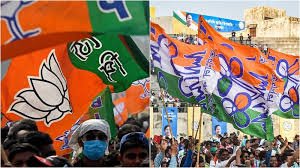
New Delhi: Elections in West Bengal have always been fiercely contested, and as the state heads towards the 2026 Assembly elections, the political battleground has been set once again. The latest controversy revolves around the Bharatiya Janata Party (BJP) and the All India Trinamool Congress (TMC), with both parties locked in a heated dispute over alleged “ghost voters” in the state’s electoral rolls.
At the center of the controversy is the TMC’s initiative to scrutinize voter lists and identify what it calls “fraudulent and duplicate voters.” However, the BJP has alleged that this drive is a covert attempt to remove Hindu refugees and linguistic minorities from electoral rolls, thereby disenfranchising those communities that are perceived to be anti-TMC. The BJP has now launched a counter-campaign, urging affected voters to report any wrongful removal from the voter list and ensuring that no legitimate voter is left out before the crucial 2026 elections.
The escalating political war over voter rolls is not just a procedural issue but a battle for electoral dominance in West Bengal, where the BJP has been trying to make significant inroads against Mamata Banerjee’s well-entrenched TMC government.
The Voter List Controversy: Allegations and Counter-Allegations
The TMC’s campaign to identify “ghost voters” was launched to purge the electoral rolls of fraudulent entries. Firhad Hakim, a senior TMC leader and the mayor of Kolkata, spearheaded the initiative in Bhabanipur—Chief Minister Mamata Banerjee’s home constituency. Hakim claimed that the BJP, with the alleged approval of the Election Commission (EC), had illegally registered voters from Gujarat, Punjab, and Haryana in West Bengal. To counter this, the TMC ordered a 10-day drive to identify and remove suspected fake voters.
The BJP, however, has strongly opposed the initiative, calling it a deliberate move to suppress Hindu and non-Bengali voters, many of whom are believed to be anti-TMC. Leader of Opposition Suvendu Adhikari accused the ruling party of trying to manipulate voter lists to favor itself. Adhikari also urged the Election Commission to take action against state officials who he claimed were complicit in the alleged voter suppression scheme.
BJP leaders have particularly raised concerns over officials in districts like Nadia, North 24-Parganas, and Kolkata, where they claim that state officers are acting in favor of the TMC by unfairly dropping voters from electoral rolls. In response, the BJP has begun a door-to-door verification campaign in Bhabanipur, checking if Hindu and non-Bengali names are being removed.
BJP’s Strategy: Countering the Alleged Voter Suppression
To combat what it sees as an attack on its voter base, the BJP has launched a massive grassroots campaign to monitor the voter verification process. The party has urged its workers to identify and challenge any wrongful deletions from the voter list.
In urban constituencies with a high concentration of non-Bengali and Hindu voters, like Barrackpore, Asansol, and Bhabanipur, BJP teams are reaching out to citizens to verify whether their names are still on the rolls. The party has promised legal assistance to those who have been wrongfully removed, ensuring that every voter’s name is reinstated before the 2026 Assembly elections.
BJP Rajya Sabha MP Samik Bhattacharya took the attack further by alleging that TMC had previously benefited from duplicate and fake voters, helping them secure election victories. He claimed that the BJP had compiled a database proving these allegations, but now the TMC was attempting to remove Hindu voters under the pretext of cleaning up voter rolls.
BJP leader Anupam Bhattacharya has focused on Bhabanipur, stating that the party has already begun preliminary work to identify voters being removed. Bhattacharya said that in the 2024 general elections, the BJP secured leads in five out of eight Kolkata Municipal Corporation (KMC) wards in Bhabanipur, indicating strong anti-TMC sentiment in the constituency. The BJP fears that if names are removed from the voter list, the party will lose its edge in key constituencies.
The TMC’s Defense: “Cleaning Up the Voter List” or Political Tactics?
While the BJP has framed the TMC’s drive as an attempt at voter suppression, the TMC has maintained that the initiative is necessary to ensure clean and fair elections. Firhad Hakim argued that the identification of “ghost voters” is a legitimate process meant to remove fraudulent registrations and duplicate voter IDs from the system.
The TMC has rejected the BJP’s accusations, stating that the removal of fake voters benefits all parties equally. They claim that the BJP’s resistance to the voter verification drive suggests that it wants to retain fraudulent voters to manipulate elections.
A Pre-Election Power Struggle
This controversy is more than just a technical dispute over electoral rolls—it is a strategic power struggle between the BJP and TMC ahead of the 2026 West Bengal Assembly elections. With the BJP steadily gaining ground in urban and semi-urban areas, the TMC is keen to hold onto its dominance, especially in areas where it has been challenged.
Both parties have strong political motives behind their actions. The BJP wants to consolidate its voter base and ensure that Hindu and non-Bengali voters remain on the electoral rolls, while the TMC wants to safeguard its strongholds by removing what it considers fake or duplicate voters.
The real question is whether this voter verification drive will be conducted fairly, without bias from state government officials or political interference. If genuine voters—regardless of their religious or linguistic identity—are being removed, it would be a serious violation of democratic principles. However, if actual ghost voters exist, removing them would be a necessary step towards electoral transparency.
Conclusion: The Road to 2026—A Battle Over Voter Identity
As West Bengal gears up for the 2026 Assembly elections, the battle over voter lists is set to intensify. With accusations flying from both sides, it is crucial for the Election Commission of India (ECI) to intervene and ensure a fair, unbiased verification process.
If the TMC is truly committed to removing only duplicate voters, it must be transparent about its methodology to prevent targeted disenfranchisement. Similarly, the BJP’s campaign must remain focused on legitimate voter protection, rather than using the issue for political mobilization alone.
West Bengal’s electoral history is marked by high-stakes battles and allegations of rigging, making voter integrity a critical issue. With both the BJP and TMC preparing for an intense electoral fight, the outcome of this voter list controversy could play a decisive role in shaping the political future of the state.
The post BJP vs TMC: The Battle Over West Bengal’s Voter List Intensifies appeared first on Global Governance News- Asia's First Bilingual News portal for Global News and Updates.