

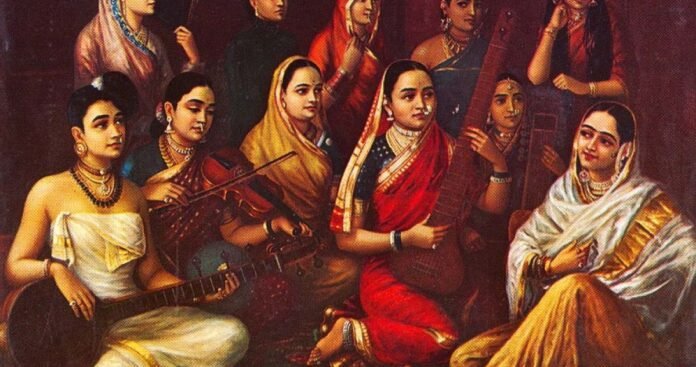
The term “feminism” does not originate from ancient Hindu civilization, nor is it found in any sacred or historical texts of Bharat. Hindu culture, rooted in profound spiritual traditions, revered women as goddesses, with figures like Saraswati, Lakshmi, and Durga embodying the highest ideals of power, wisdom, and prosperity. Women in ancient Bharat enjoyed significant respect, with rights to education, property, and spiritual participation. Their roles were multifaceted, as creators, nurturers, and warriors.
However, the decline in women’s status in Bharat began only after repeated foreign invasions that disrupted its socio-political fabric. These invasions led to the subjugation of women, as foreign rulers imposed foreign norms that undermined the rights and roles of women in society. This deterioration was not due to indigenous cultural practices but to the external forces that sought to dominate and destroy the native way of life.
The word “feminism” emerged from the socio-political evolution of Europe and later found its way into India, a result of colonial influence. It is a foreign concept that was introduced after centuries of disruption to the natural order of Indian society. Thus, while the principles of gender equality have always existed in Hindu civilization, feminism, as a modern term, was imported into Bharat from the West.
Women had a sacred and integral place in ancient Bharatiya (Indian) society, deeply ingrained in the religious and social heritage of Sanatan Dharma. Women were not just objects of worship during the Vedic era; they were thinkers, intellectuals, scholars, and essential building blocks of the civilization’s advancement. Their equality, respect, and power in society were not achieved through hardship but were a natural part of the system, a reflection on the superior thinking of the era.
The colonization, particularly under British rule, had a deep impact on the Saanatan (Hindu) civilization, reshaping its intellectual, social, and cultural fabric. The British introduced foreign ideas systematically, which tended to have little bearing on the traditional practices and philosophical structures of Indian society, thus separating European thought from native ways of life. This invasion of culture was not restricted to physical conquest but penetrated into the very core of Indian thinking, resulting in the sidelining of Hindu practices and the emergence of a colonial mentality that considered European civilization superior.
During British rule, the imposition of a Western education system actively discredited India’s ancient systems of knowledge. Sanskrit, the vehicle of Hindu scripture wisdom, was pushed aside in favor of English, and ancient India’s philosophical, spiritual, and scientific contributions were either disregarded or distorted. British academics and orientalist intellectuals tended to reinterpret Hindu scripture to fit their agenda, drawing attention to points like the caste system while ignoring the profound spiritual and philosophical wisdom inherent in Hinduism. This provided an intellectual setting in which European notions were viewed as unwaveringly progressive and rational, whereas native ways were condemned as primitive or backward.
Additionally, the British “divide and rule” policy fueled pre-existing social divisions. By strengthening and rigidly dividing the caste system, the British solidified societal divisions further. This manipulation not only intensified pre-existing fissures but also helped in the development of insecurities in Indian society so that individuals doubted the applicability of their own values and traditions. The positive encouragement of Christianity through missionary activity further added to this by presenting Hinduism as inferior and requiring reform.
The most enduring legacy of British colonial rule was the imposition of a hierarchy of culture, in which European values were used as the measure of excellence and traditional Hindu values were pushed to the periphery. This has resulted in a shared sense of inferiority in which people have come to believe that Western civilization was the highest form of advancement. The legacy of this frame of mind still permeates contemporary India, but there has been a return in recent centuries of attempts to recover and reassert the applicability of Saanatan civilization. Through the revisiting of native knowledge systems and philosophy, it is increasingly recognized that these must be brought into harmony with global thought today, restoring the integrity and validity of India’s cultural heritage in the contemporary age.Similarly the Feminism in modern times that had entered in the Sanatan society.
The Vedic writings themselves, among the oldest on the planet, are overwhelming evidence of the deep respect and stature women held. In these texts, women like Gargi and Maitreyee were not only honored but also recognized as intellectual equals. Gargi, for example, is known for her discussion with scholars in the court of King Janaka, where the respect given to women as philosophers and teachers is reflected. Likewise, the rich philosophical dialogue of Maitreyee as evidenced in the Brihadaranyaka Upanishad reveals the extensive intellectual and spiritual contribution of women to society.
The Vedic era idea of equality of men and women was deeply based on the belief that both were manifestations of the same divine power, Shakti. This has been evidenced in social organization that allowed women to be central decision-makers across many aspects of life. They took part in religious rites and rituals, made sacrifices, and played the role of guardians of the family and the well-being of the community. Such practices as Swayamvara empowered women to have control over whom they chose as life partners, pointing towards the autonomy women exerted in matters of the personal domain. Unlike most modern societies, women in ancient India enjoyed great social and religious significance, garnering respect for their intelligence, sagacity, and contribution to cultural evolution.
Women’s role was not limited to the spiritual and intellectual plane. Ancient texts, such as the Arthashastra, also mention women as political entities, military commanders, and students of statecraft. Chhatrapati Shivaji Maharaj’s mother, Jijabai, women like her were not just objects of maternal love but also warriors and leaders who dominated the political arena of their epochs. These women were manifestations of power, strength, and leadership, even more highlighting the ability of women in ancient India to guide civilization.
But all this golden period of equality came to be prematurely cut short with a series of foreign invasions on Sanatan Hindu civilization.With the advent of foreign powers like the Mughals and thereafter the British colonialists, the social setup which had raised the status of women started deteriorating. Invasions introduced patriarchal values, oppression of women’s independence, and a distortion of the native cultural norms that had previously maintained their dignity. The change in cultural norms during these foreign conquests was not only a political or military defeat but an erosion of culture which took away women’s rights and status.
Against this backdrop of historical turmoil, the whispers of the ancient Vedic era remind us of the proper role of women in society — as equals, leaders, and participants in the spiritual and cultural advancement of civilization. The glorious heritage of ancient Indian women, who once influenced the course of history, still inspires the struggle for gender equality in contemporary times. Though the journey has been tainted with centuries of adversity, the teachings of the past are a potent call to renew the honor and equality that formerly characterized the women of Bharat.
Contrarily Feminism was born and emerged as a reaction to systemic sexism and unfairness that European women experienced all over history. The movement had tried to upend and stop the oppression of women, stand for their rights, equality, and empowerment across the different spheres of life. The following are some of the reasons why feminism was born and came into being and also some overview of how things were before the 17th century:
Reasons for the Origin and Development of Feminism in Europe
Patriarchal Societies and Gender Inequality:
Historically, European societies were organized in ways that favored men and restricted women’s roles and rights. Women were often seen as inferior to men, both biologically and intellectually. This patriarchy was institutionalized in laws, religion, and culture.
Limited Legal and Political Rights:
Prior to the feminist movements, women in most European societies held no or few legal rights. Women in Europe were not allowed to own property, vote, or participate in political decisions.
Their occupation was usually limited to household chores, and marriage often involved a legal displacement of a woman’s rights to her husband.
Women were typically economically reliant on their fathers, husbands, or male kin. Women had limited access to economic independence, and their work opportunities were restricted to low-paid, gender-segregated labor (usually in domestic service or textile manufacture.
Women were not provided with formal education or entry into intellectual spheres. While men were allowed access to universities, women’s education was usually geared towards domestic arts or religion and not towards subjects that would empower them to control society.
Men controlled women’s bodies and reproductive rights, and there were minimal to no legal rights in relation to reproductive health. Women’s identity was based on their role in reproduction, and women were pushed by social expectations into marriage and motherhood.
The 17th and 18th-century Enlightenment brought with it notions of individual rights, liberty, and equality. Thinkers such as Rousseau and John Locke contributed to the idea that all human beings should be equally treated, and these notions set the foundation for feminist ideology.
The early feminist movements in Europe were usually connected with larger social and political reform movements, like abolitionism and labor rights. Women involved in these movements started to demand gender equality as a part of their activism.
Women in pre-17th-century Europe enjoyed few legal rights. They were generally regarded as being under the authority of their fathers or husbands. A married woman, in most legal systems, was “covert” for legal purposes, i.e., she had no separate legal existence from her husband. In some regions of Europe, women were not allowed to own property, enter into legal contracts, or control their finances.
Marriage was at the core of a woman’s identity and existence. Women were to marry, give birth, and manage the home. The “good wife” was based on submission and obedience to the husband. Women’s activities were mainly focused on household chores, such as cooking, cleaning, child care, and keeping the house.
Women had limited possibilities to acquire money on their own. They were mostly confined to unpaid household work. The well-off women did have some influence within the home, but their economic independence remained highly restricted. Working-class women might need to engage in hard work like textile industries, working in agricultural fields, or household service, but their salaries were meager, and they did not enjoy much job security.
The major religions of Europe, particularly Christianity, reasserted women’s secondary status. Women were commonly depicted as inherently sinful (e.g., the biblical legend of Eve), and their main responsibilities were to tend the home and bear children. Religious writings tended to promote women’s submission, chastity, and obedience.
The education of women was highly restricted, particularly for the lower classes. Noblewomen or women from upper-class families may have learned some education, which was usually aimed at running households, religious teachings, and foundational literacy. Most women, on the other hand, were not educated beyond domestic skills.
Females had very little say in their right to reproduction. Abortion and contraception were not easily accessible, and most women ended up with large families accordingly. The high death rate among women as a result of childbearing was also an important aspect of their experience in life.
Feminist Movement Emergence:
Feminism started to become more established in the late 18th century, with authors like Mary Wollstonecraft, who penned A Vindication of the Rights of Woman (1792), advocating women’s education and equality. From the 19th century, different waves of feminism have evolved, each working on different issues such as suffrage, reproductive rights, and equality in the workplace.
In summary, feminism emerged as a response to the pervasive disparities encountered by women in every sphere of life—politically, legally, economically, and socially. The status of women in Europe prior to the 17th century was defined by limiting gender roles and structural disadvantages, their rights and liberties held closely by the patriarchal infrastructures of society.
In comparing ancient Bharat (India) and Europe, particularly the role of women, with Europe specifically within the realm of feminism, it can be noted that the idea of feminism as we have come to know it today was not as needed in ancient India. The reason behind this is that Sanatani Hindu civilization inherently bestowed rights and respect upon women, and a joint family system was practiced with women receiving prominent roles in decision-making within family, religious, and civil life. These cultural norms gave women a degree of agency and autonomy that was, in most instances, more developed than their European peers of the same era .
The joint family system in ancient Bharat was an important factor that empowered women. The joint family system encouraged a communal and collective way of doing things, whereby decisions were taken collectively, involving all members, including women. Women played a role in family decisions, from child rearing to marriage and economic decisions. This cultural phenomenon gave women significant power within the family, making sure that their opinions were heard and their well-being taken into account. Even in the broader society, women occupied dignified places in society which we find very less if European History is mentioned.
Women in ancient Bharat and their presence in the philosophical and religious aspects of society was a reflection of the esteem for women’s intellectual capabilities. In addition, works such as the Manusmriti and Dharmashastras recognized and preserved women’s rights, guaranteeing their safety, dignity, and right to inherit property.
Conversely, at the same time in Europe, women’s status was generally restricted. European societies, especially in medieval and ancient times, were mostly patriarchal. Women were mostly confined to the domestic sphere, with minimal access to education and even less to governance or intellectual pursuits. Women’s rights, such as property ownership and the right to decide, were largely curtailed, and their contribution to public life was minimal.
The absence of a necessity for feminism in ancient Bharat, in the context of these cultural traditions, implies that women were mostly considered equals in society, free from the institutionalized oppression that necessitated the emergence of feminism in Europe during the 18th and 19th centuries. Western feminism developed out of the need to reverse gender disparities and seek fundamental rights such as voting, property rights, and education—rights already enjoyed by women in Bharat, to some degree.
But it should be noted that colonial influences and the resulting transformation in Indian society did come to change women’s status in the long run. In spite of this, the foundations of women’s rights in Bharat were firmly established in its culture, and the tradition of respect for women continues to be a major part of traditional Indian values even today.
Feminism, both as a movement and philosophical credo, has its roots in the European historical struggle for gender equality, promoting women’s social, political, and economic rights. Emerging in the late 19th century, the first wave of feminism was concerned mainly with legal inequalities, including women’s suffrage and rights to property. Preceptors like Mary Wollstonecraft, in her classic essay A Vindication of the Rights of Woman (1792), resisted prevailing patterns of domination that entrench women’s subordination and demanded women’s right to education and participation in society. The philosophy of feminism in all its stages is oriented towards dismantling patriarchal structures of long-time oppression that have silenced and marginalized women. The second wave, emerging in the 1960s and 70s, expanded its platform to encompass reproductive rights, job discrimination, and sexual freedom, with Simone de Beauvoir and Betty Friedan articulating the nuances of women’s lived experience through texts such as The Second Sex (1949) and The Feminine Mystique (1963). Feminism’s objectives evolved from these initial calls for legal equality to a more profound examination of the ways in which gender norms are socially constructed and how those constructions perpetuate women’s second-class status compared to men. Central to feminist thought is the rejection of essentialism—the assumption that biological sex dictates gender roles. Instead, feminists hold that gender identity is socially conditioned, and thus individuals should not be limited to sex-based roles. Third-wave feminism, which emerged in the 1990s, broadened the focus to include race, class, and sexuality intersections, emphasizing the necessity of understanding women’s different experiences. Bell hooks as well as Kimberlé Crenshaw have been central thinkers in the development of this perspective, with hooks encouraging a radical reordering of love, power, and social change (Feminism is for Everybody, 2000), and Crenshaw incorporating the concept of intersectionality, which is an acknowledgement of how the different oppressions—race, sexism, and classism—intersect and cross one another. The feminist movement now still works against overt and implicit forms of oppression, striving not only to tear down legal proscriptions but the deeply entrenched structural and cultural norms that keep reinforcing gender disparities. Its philosophy is not that of inclusion but liberation, trying to create a world where everybody, regardless of their gender, enjoys freedom from limitations imposed by systems of power. Feminism is therefore a living, dynamic force, constantly reinventing itself in its quest for equality, justice, and freedom
The post Sanatan Hindu Civilization and Feminism appeared first on Global Governance News- Asia's First Bilingual News portal for Global News and Updates.