

Paromita Das
GG News Bureau
New Delhi, 6th November. In a candid and scathing critique, former Punjab Chief Minister Captain Amarinder Singh has openly condemned Canadian Prime Minister Justin Trudeau for his alleged support of Khalistani separatists, accusing him of damaging Bharat-Canada relations for political gain. Singh’s remarks reflect growing tensions, as the Trudeau administration faces criticism for harboring separatist leaders within its ranks and enabling anti-Bharat activities on Canadian soil. This explosive statement arrives amid the diplomatic strain following Trudeau’s accusations against Bharat for the assassination of Khalistani separatist Hardeep Singh Nijjar—a claim the Canadian leader himself later admitted was not supported by concrete evidence.
Trudeau’s Allegations and Singh’s Response
Captain Amarinder Singh’s response comes at a time when diplomatic ties between Bharat and Canada are under unprecedented strain. Singh decried Trudeau’s decision to accuse Bharat in Canada’s parliament over Nijjar’s death, emphasizing that such unfounded claims undermine the sanctity of parliamentary discourse. “The assassination of a person of extreme separatist views Hardeep Singh Nijjar led to [Trudeau] pointing his finger, in a parliamentary statement, towards Bharat as being responsible for this act,” Singh stated. He highlighted the inconsistency in Trudeau’s claims, especially since the Canadian leader later admitted that no concrete evidence supported the allegations.
Amarinder Singh pointed out that Trudeau’s actions have damaged the trust between the two nations, questioning whether political ambitions outweigh the value of decades-old alliances. Singh’s implication is clear: Trudeau appears willing to risk diplomatic stability to appease certain domestic groups, a move Singh deems irresponsible and politically short-sighted.
Past Encounters: Singh’s Stand Against Khalistani Influence
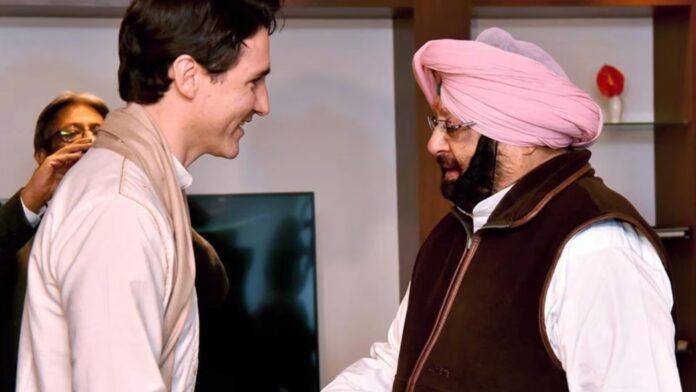
Singh has long been vocal about Canada’s growing support for Khalistani factions. He recalled instances from his tenure as Punjab’s Chief Minister when Trudeau’s government showed concerning sympathy for the separatist movement. During Trudeau’s visit to Bharat, Singh had refused to meet a Canadian representative with known links to the Khalistani movement, marking a low point in Bharat-Canada relations at that time. Singh also mentioned how Trudeau brought his defense minister, Harjit Sajjan, to Punjab as an apparent show of force—a move Singh described as Trudeau’s attempt to challenge him on home ground.
During their meeting, Singh reportedly handed Trudeau a list of more than twenty Canadian individuals involved in pro-Khalistani activities, some of whom held government positions. Trudeau’s promise to investigate these concerns, however, yielded no visible outcomes. Instead, Singh noted, Khalistani influence in Canada has only intensified, with separatists allegedly involved in gun-running, drug smuggling, and organized crime, worsening the law-and-order situation in Punjab.
The Use of Diaspora Politics and Singh’s Accusations of Irresponsibility
Singh also accused Trudeau of using Canada’s Punjabi diaspora as a vote bank, claiming that the Prime Minister’s overtures to the Khalistani faction are part of a larger electoral strategy. According to Singh, while other nations with separatist elements maintain strict checks on such movements, Canada has gone so far as to legitimize them. “In the case of Canada, a government that patronizes a terrorist or a separatist movement for political gain is irresponsible and to a point criminal,” Singh remarked, adding that Trudeau’s perceived pandering could ultimately backfire, weakening his influence within Canada’s broader Punjabi community.
This politicization of separatist sentiment, Singh suggested, has created a dangerous environment, emboldening extremist factions that pose a threat not only to Bharat but also to Canadian society. Singh warned that this strategy has eroded Trudeau’s credibility both in Bharat and among moderate Punjabis in Canada who are increasingly disillusioned with his handling of extremist groups.
Bharatiya Diplomacy Responds: Jaishankar’s Condemnation
Bharat’s stance on the matter has remained clear and assertive. Foreign Minister S. Jaishankar recently criticized Canada for allowing anti-Bharat extremists to operate freely, stating that Canada has a “pattern of making allegations without providing specifics.” He also condemned the recent attack on Brampton’s Hindu Sabha Temple, where pro-Khalistani demonstrators disrupted a Diwali event and targeted devotees. Jaishankar expressed outrage over Canada’s inaction in curbing such activities, which he described as direct attacks on Bharat’s sovereignty and diplomatic missions.
Jaishankar’s Australian counterpart, Penny Wong, voiced support, describing the temple vandalism as “upsetting” for the Bharatiya community. The Indian Ministry of External Affairs also released a statement demanding that Canada protect Bharatiya sites and prosecute those involved in such violent incidents. Prime Minister Narendra Modi himself took to social media, condemning the attacks as “cowardly” and calling on Trudeau’s administration to uphold the rule of law.
Trudeau’s Isolation and International Backlash
Canada’s handling of the Khalistani issue has drawn mixed international reactions. While some allies maintain diplomatic neutrality, others have expressed concerns regarding Canada’s lack of control over separatist groups operating on its soil. Trudeau’s decision to name Bharatiya officials in his allegations and his unwillingness to present evidence have isolated him further, weakening his standing as a leader on the global stage. Trudeau’s support base within Canada’s diaspora communities is also reportedly showing signs of division, with moderate voices calling for a balanced approach that does not sacrifice national security for political interests.
Conclusion
Captain Amarinder Singh’s remarks highlight a critical moment in Bharat-Canada relations, where the actions of one nation’s leader could reshape a historically strong friendship. Singh’s condemnation of Trudeau underscores a larger narrative of perceived irresponsibility in allowing extremism to flourish for political gain. Singh’s direct critique, backed by Bharat’s diplomatic response, reflects Bharat’s growing frustration with Canada’s reluctance to address Khalistani extremism seriously.
The Bharat-Canada diplomatic rift raises questions about the ethical limits of diaspora politics and the responsibility of leaders to prioritize national and international security over electoral gains. Captain Amarinder Singh’s concerns, rooted in first-hand experiences, resonate deeply. His account reveals that Trudeau’s reluctance to act on pro-Khalistani elements is more than just political theater; it’s a serious issue that threatens stability in Punjab and damages Canada’s international standing.
Bharat has every right to demand that its allies treat threats to its national security with gravity. Trudeau’s approach, which appears to prioritize his vote bank over long-standing diplomatic relations, is indeed troubling. Canada’s tolerance of Khalistani extremism not only harms its relationship with Bharat but also destabilizes its own multicultural landscape, alienating communities that do not subscribe to radical ideologies.
Ultimately, leaders have a duty to protect the fabric of international cooperation. Singh’s candid statements underscore the risks of Trudeau’s strategy, warning of the consequences when diplomacy is compromised for domestic gain. As Singh aptly noted, real progress will come only when Canada respects its commitments to global security, fostering an environment where mutual respect—not political expediency—guides foreign relations.
The post Amarinder Singh Slams Trudeau for Backing Khalistani Extremists, Damaging Bharatiya Ties appeared first on Global Governance News- Asia's First Bilingual News portal for Global News and Updates.