

Paromita Das
GG News Bureau
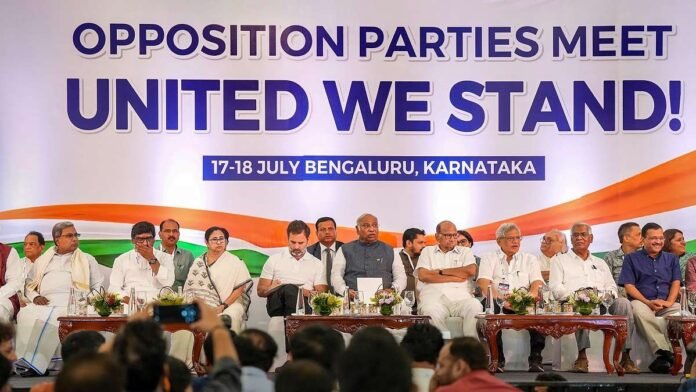
New Delhi, 11th Feb. The recent landslide victory by the Bharatiya Janata Party (BJP) in Delhi has illuminated deep fissures within the Indian National Developmental Inclusive (I.N.D.I.) Alliance, exposing its inherent contradictions and severe vulnerabilities. While the contest was initially seen as a battle between the I.N.D.I. Alliance and the National Democratic Alliance (NDA), it ultimately boiled down to a direct fight between the Aam Aadmi Party (AAP) and BJP. Although BJP’s tally of 48 seats dwarfed AAP’s 22, the real story lies in the internal dynamics that led to AAP’s significant losses, particularly at the hands of its own coalition partner, Congress. This analysis explores how Congress’s decision to contest all 70 assembly seats, despite internal differences, led to a string of losses for AAP and further complicated the already fragile alliance structure.
Congress’s Role in AAP’s Setback: The Congress party’s involvement in the Delhi elections marked a stark shift from the usual alliance politics. By contesting 70 seats—four more than its 2020 figure—Congress managed to siphon off crucial votes, leading to the defeat of prominent AAP leaders such as Arvind Kejriwal, Manish Sisodia, Saurabh Bharadwaj, and others. The Congress strategy to “sabotage AAP” was particularly evident in constituencies like New Delhi, Greater Kailash, and Malviya Nagar, where AAP had historically been strong. Congress’s decision to fight all seats created an electoral challenge for AAP, which was already struggling to maintain its image as a party of modernization and governance.
The underlying motivation for Congress’s actions seemed twofold: it was an attempt to avenge its losses in Gujarat, Goa, and Haryana, and a bid to reclaim political relevance. Rahul Gandhi’s ecosystem, having long desired to see his leadership strengthened, embraced this moment of victory. The 99 seats Congress secured was a clear indication of its attempt to re-establish itself as a central player in national politics. However, this win came at the expense of both alliance cohesion and ideological consistency, as Congress’s tactics of competing for Muslim and Dalit votes clashed with those of regional partners in the alliance.
Internal Contradictions and Fragmentation of I.N.D.I. Alliance: While Congress’s actions in Delhi were just one chapter, they epitomize the broader issues plaguing the I.N.D.I. Alliance. With over two dozen parties in its fold, ranging from regional powerhouses to smaller factions, the alliance’s structure is inherently unstable. Internal contradictions are particularly stark in states like West Bengal, where Mamata Banerjee’s Trinamool Congress (TMC) is at odds with the Left parties. The tussles within the alliance over issues such as the Waqf Bill, seat-sharing, and ideological divisions have made it difficult to present a united front against the BJP.
The alliance’s challenges are not confined to Delhi. In states like Maharashtra, Jharkhand, and Bihar, Congress’s attempts to strengthen its position through seat-sharing agreements have led to internal conflicts and rivalry with regional parties. The ongoing tussle in Bihar, where Congress and regional ally RJD are jostling for control over Dalit and Muslim votes, is a prime example of how regional politics often undermines broader national unity within the alliance.
The Battle for Dalit and Muslim Votes: Congress’s focus on Muslim and Dalit votes has intensified in recent years. In states like Bihar and Uttar Pradesh, the party is increasingly aligning itself with far-left factions, hoping to consolidate the Dalit and Muslim vote banks. This approach, however, has not been without its risks. In Bihar, the entry of Prashant Kishor, a political strategist with ties to the BJP, has created uncertainty, as both Congress and RJD are vying for Muslim support. Similarly, in Uttar Pradesh, Congress’s ambition to increase its seat share is clashing with regional powerhouses like Samajwadi Party (SP) and Bahujan Samaj Party (BSP), which are also competing for the same constituencies.
The I.N.D.I. Alliance, as it stands today, appears fundamentally fractured. The strategic maneuvering by Congress has destabilized its relationships with key regional partners, and its obsession with regaining Muslim and Dalit support has pushed the alliance towards ideological extremism. For Congress to secure its place in national politics, it must find a way to reconcile its ambitions with the realities of regional power dynamics. The alliance’s internal rifts, compounded by personal ambitions and ideological differences, suggest that without a major realignment, the I.N.D.I. Alliance will continue to struggle in the face of a unified BJP-led NDA.
Conclusion: The future of the I.N.D.I. Alliance is uncertain. While its potential for uniting against the BJP remains an option, its internal divisions, amplified by Congress’s approach, will make any coherent strategy difficult to execute. As regional parties continue to assert their autonomy and ideological purity, the alliance faces an uphill battle in the run-up to future elections. Without a concerted effort to resolve these contradictions and address the broader electoral dynamics, the I.N.D.I. Alliance risks fading into irrelevance, leaving the BJP unchallenged at the national level.
The post INDI Alliance’s Fragile Unity: A Delicate Dance of Rivalries and Ambitions appeared first on Global Governance News- Asia's First Bilingual News portal for Global News and Updates.