

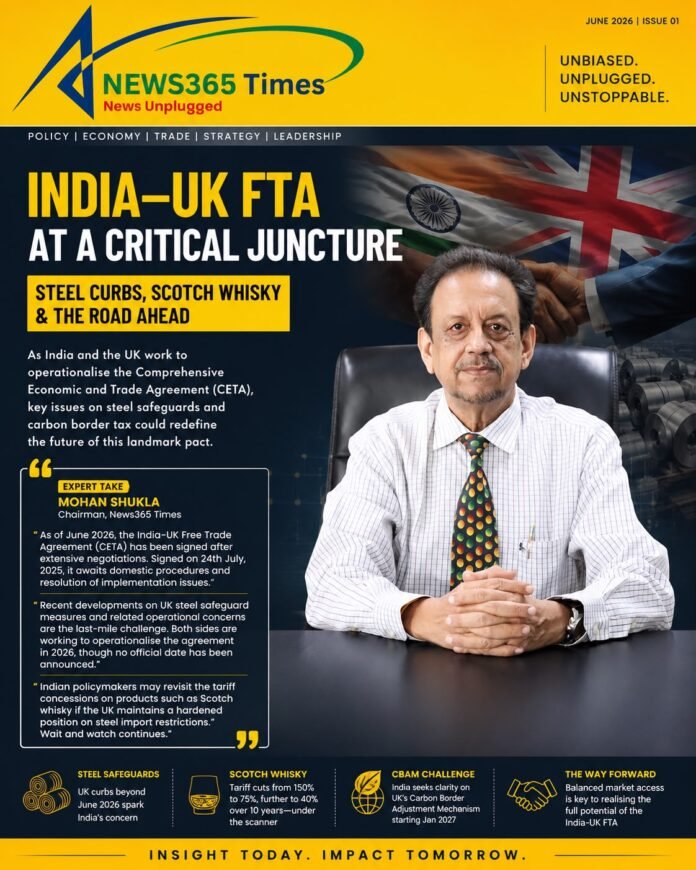
The India-UK Comprehensive Economic and Trade Agreement (CETA), hailed as one of the most significant bilateral trade agreements signed by India in recent years, is facing an important implementation challenge even before formally coming into force.
Signed on 24 July 2025 after extensive negotiations between the two nations, the agreement promises duty-free access for 99% of Indian exports to the UK while providing substantial tariff concessions on several British products, including Scotch whisky, automobiles, cosmetics and medical devices.
However, despite the signing of the agreement, implementation remains pending as both countries continue to complete domestic ratification procedures and address certain operational and policy concerns.
Steel Safeguards Emerge as a Key Concern
The latest point of contention is the United Kingdom’s decision to continue safeguard measures on certain steel imports beyond June 2026. While London maintains that these measures are necessary to protect domestic manufacturers from a surge in low-cost imports, Indian exporters believe the restrictions undermine the spirit of market access promised under the FTA.
In response, Indian policymakers have indicated that tariff concessions granted to British exports, particularly Scotch whisky, could be revisited if UK steel restrictions remain in place.
Scotch whisky was among Britain’s most significant gains under the agreement. India had agreed to reduce import duties from 150% to 75% upon implementation, with tariffs eventually declining to 40% over a ten-year period.
CBAM Adds Another Layer of Complexity
Alongside steel safeguards, New Delhi is also seeking greater clarity on the United Kingdom’s proposed Carbon Border Adjustment Mechanism (CBAM), scheduled for introduction in January 2027.
The proposed carbon tax on emissions-intensive imports such as steel and aluminium has raised concerns among Indian industry stakeholders, who fear that such measures could create new non-tariff barriers and dilute the commercial benefits negotiated under the FTA.
India has consistently argued that climate-related trade measures should not become instruments of disguised protectionism.
A Delicate Balancing Act
The current developments underscore the changing nature of global trade, where market access is increasingly influenced not only by tariffs but also by sustainability standards, carbon regulations and domestic industrial policies.
While both governments remain committed to operationalising the agreement, the resolution of steel safeguard measures and CBAM-related concerns may prove critical to ensuring the long-term success of the partnership.
Expert View
According to Mohan Shukla, Chairman, News365 Times:
“As of June 2026, the India-UK Free Trade Agreement, officially known as the Comprehensive Economic and Trade Agreement (CETA), has been signed after extensive negotiations and deliberations between two great nations. Although the agreement was signed on 24 July 2025, it has yet to come into force as certain domestic procedures and implementation-related issues remain to be resolved.”
“Recent developments surrounding UK steel safeguard measures and related operational concerns have emerged as a last-mile challenge. Statements from officials on both sides indicate a shared intent to operationalise the agreement during 2026, though no formal commencement date has yet been announced.”
“Most importantly, Indian policymakers may revisit the tariff concessions extended to products such as Scotch whisky if the UK maintains a hardened position on steel import restrictions. The situation remains fluid and merits close observation. Wait and watch continues.”
The Road Ahead
The India-UK FTA represents far more than a trade agreement. It is a strategic economic partnership between two major democracies seeking deeper commercial integration in an increasingly uncertain global trade environment.
The coming months will determine whether both sides can successfully address the remaining concerns and ensure that the spirit of reciprocity, fairness and market access envisioned under the agreement is fully realised.
For now, the message from New Delhi appears clear: trade concessions and market access must remain balanced, equitable and mutually beneficial.