

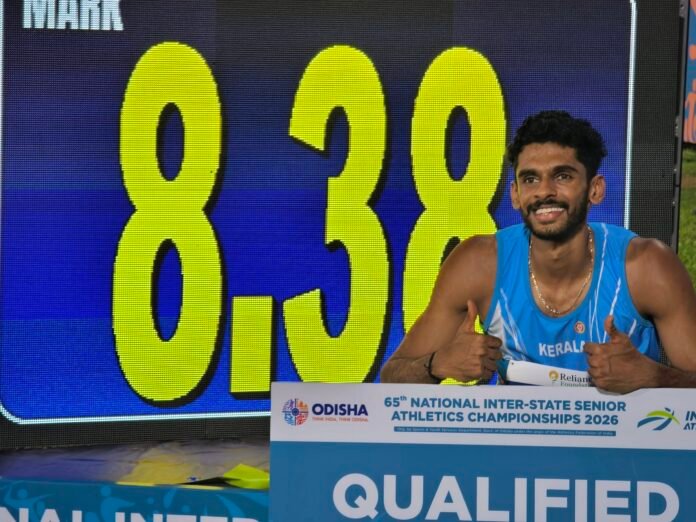
Four weeks out from his Asian Games final, Murali Sreeshankar is already in Japan, fine-tuning his preparation at the University of Tsukuba. The star Indian long jumper, in an exclusive conversation with RevSportz Editor-in-chief Boria Majumdar, talks about adapting to Nagoya’s heat and humidity, his comeback from injury, how he prepares for the jumps in demanding situations, the importance of breathwork, learnings from handling pressure and why India will miss Neeraj Chopra’s presence in the camp.
Here are the excerpts:
Boria: You are already in Japan and have been training there. Give me a sense of how things are. What have your plans been since Glasgow? How did things shape up? Are you back to training now? What is the final stretch looking like?
Sreeshankar: There are only four weeks left for the Asian Games, and preparation has been wonderful. After Glasgow, the goal was to recover well. I also competed in a continental silver event in Bhubaneswar. I was expecting to put up a good performance, but I had a very bad stomach upset two days before the event, which hampered my performance a bit. After that competition, the goal was to recover and be at my best. I had a good recovery week, which I could spend at home.
Then we travelled to Japan. Currently, I am training at the University of Tsukuba until 23 September, then will head for the Asian Games.
The reason I came a bit early was because this four-week training block here in Tsukuba will really help me adapt to the conditions. My body also has to respond the way it should at the Asian Games. We had a similar training stint before the Commonwealth Games in Spala, which helped us acclimatise to the cold conditions. My body was responding very well in Glasgow despite the cold weather.
So I requested the AFI that I needed to travel four weeks prior to the Games, and they allowed me to travel with my coach. We started training yesterday, and so far, so good.
Boria: What is the weather like? What are you expecting in your case at the moment and what is better for a perfect jump?
Sreeshankar: The weather here in Tsukuba for the past two or three days has been very ideal. The temperature is around 27 degrees now. Yesterday I was training in the evening and there was no wind. It was very stable, with no humidity. I had an intense session and I was actually enjoying my session.
But when I spoke to coaches and athletes here, they said the coming days are expected to be very hot and the humidity is supposed to be around 90%. That is the kind of weather we can expect in Nagoya as well.
We have to change our strategies accordingly, but I feel that for us Indian athletes, hot and humid shouldn’t be a big problem. Most of our domestic events have always happened in hot and humid conditions – Ranchi, Bhubaneswar, Chennai.
So compared to the cold conditions in Glasgow, I feel our athletes will be able to adjust to hot and humid conditions much better. There is nothing extra we have to do to combat the heat and humidity. We have to do good mobility, dynamic stretches, good activation, and then we are ready.
But in cold conditions, we have to make sure that every aspect of the warm-up is precise because we are not used to those conditions. I think Nagoya will be conducive for Indian athletes for sure.
Boria: Without Neeraj there, you and TJ will have to be the kind of leaders of the pack. Adile Sumariwalla expects around 25-plus medals. Athletics will have to deliver the bulk of the medals if India has to get to that magic number of 100 again. How are you looking at the whole thing?
Sreeshankar: Obviously, after the CWG everyone will definitely expect me to win, which I am very confident about. The training has been fantastic, and my physical condition is so good.
Thanks to Dr Wayne Lombard as well, because he helped me prepare in the best possible way. Physically, I feel that I am probably in the best shape of my life.
The only challenge for me is to adapt to the conditions there. If I am able to manage the conditions on that particular day quite well, then I can win the gold medal for sure.
Obviously, when it comes to the Asiads or CWG, especially in men’s long jump, the competition is as good as the World Championships or the Olympics. I will be going against the 2025 World Championship bronze medallist from China.
Compared to last year, I am in very, very good physical condition. My technique has been quite good, and I am in a very good physical space right now. Training has been very carefully monitored and charted, and I am really happy with the way things are progressing. So obviously, I am very confident that I can put up a very good show there.
I am also a bit sad that Neeraj Bhaiya won’t be part of the team. When he put out that Instagram post saying that he was hurt and wouldn’t be able to make it to the team, I texted him saying, “Bhaiya, I feel sorry for you. Hope you are recovering well.”
We look up to him because he has done everything in sport by the age of 25. For me, he is like a big brother and a big role model. His presence automatically improves our morale and the morale of the team.
In Glasgow, when he was there and talking to us, we were looking at him like a godfather figure giving us advice. So obviously, we will definitely miss him.
Boria: I actually felt that AFI should have convinced Neeraj to travel, if he was in a position to travel. Every athlete would have benefited from Neeraj’s presence as a mental conditioning coach, guide or advisor, as his presence in that Indian camp would have made a hell of a difference because he is Neeraj Chopra.
Sreeshankar: Definitely, I would 100% agree with that. When we sit at the dinner table and have basic, random conversations, there is always something I pick up from the conversation. If it is a World Championship, even if it is the eve of a World Championship final, Olympic Games final or Asian Games final, he is just calm and composed.
In our minds, even if we are composed, there will be thoughts running through our heads that tomorrow we have the final. But you could see that calmness on Neeraj’s face, how composed he is and how well he takes the situation.
He says, “Yeah, I feel good. So let’s give it a good shot tomorrow.” You are immediately in a very positive mindset.
Even if he is going for a major tournament, it is like any other tournament for him. The way he maintains his composure from the day he lands for a tournament until the day he leaves is the same.
Even after winning a gold medal, he doesn’t show off or do all those things. He is just the Neeraj Chopra he is.
I still remember in 2023, after winning his first World Championship gold medal. I always wake up pretty late and went for breakfast at around 10 o’clock, and Neeraj had already finished his breakfast.
He had finished his event, all his media commitments and all his interviews. He won the gold medal the previous evening and had finished all his media commitments.
The next morning, he woke up just as if it was a normal day for him. He finished breakfast even before we all came there, and he sat with us until we finished our last cup of coffee.
He was discussing how the competition went and what he had to manage. There were crosswinds, so he had to manage them.
He was also acknowledging that Arshad Nadeem had thrown quite well after the brief break he had following the 2022 season. He was talking about sport and it was just a normal thing for him. There are a lot of things we can learn from him, and that’s the reason a lot of Indian athletes look up to him as a role model.
Boria: When the countdown begins, what does an elite athlete like you do? How does someone like you, who is extremely talented and in the best physical space at the moment, approach the lead-up to competition?
Sreeshankar: To be precise, I now have exactly four weeks for my Asian Games final. Basically, I now have a solid four weeks of preparation. The first two weeks will be about tweaking the intensity and volume a bit and then it will be more about tapering down towards the Asian Games.
My major focus at this moment is putting in the good work, and the main focus will be to be healthy for the Asian Games.
I have to eat well, sleep at the right time and drink enough water because the weather will be turning very hot and humid in the coming days.
I have to make sure my hydration is proper. I have to make sure I am recovering because when humidity goes up, recovery between sessions becomes very important. When the temperature is high and the weather takes out a lot of fluids from your body, we have to make sure we are hydrating well so that we recover for the next session. I have recovery modalities that I am carrying everywhere with me.
The major chunk of the work has already been done this season because I got a solid off-season. The competition season has been going quite well. Now it is all about maintaining my physical condition, not exerting too much and staying healthy.
Boria: Does any mental conditioning or training go on? Do you do any work on that front, meditate, visualise or anything like that which elite athletes do?
Sreeshankar: I always do breathwork in the morning, sir. The first thing after getting up, after going to the washroom and freshening up, is breathwork. I do a lot of reading on how elite athletes train their diaphragm and how they train their breath.
I picked up a lot of things from Stephen Curry and Michael Jordan, and I am also reading books related to that. So I am always practising breathwork. It helps me stay in the zone. I have also found that practice really helpful during competitions. When you take a deep breath, you feel that things are under your control. Once the competition starts, the adrenaline shoots up, there is the crowd cheering and there is noise everywhere. But when you stand on the approach, it is just you, your approach and the jump.
So I have to make sure that I am in the zone. I practise meditation and breathwork every single day.
Boria: Suppose you want to give the first jump the best, or maybe the second and things don’t go to plan. Is there always a Plan B?
Sreeshankar: Absolutely, I have dealt with every sort of situation before. At the last Asian Games, my dad always said that your first jump has to be a valid jump. It shouldn’t be far off the board, and you shouldn’t foul that jump.
But for some reason, at the last Asian Games, I had probably the biggest jump I had ever done in my career, but it was fouled by a narrow margin. In a final, if you foul the first jump, that creates a huge amount of pressure. But in the next jump, I knew that given the physical condition I was in, I had to get a good jump so that I would be placed in the top eight and get the next four jumps. So we have worked around every possible scenario.
Most of those learnings happen during competitions. There have been scenarios where I was trailing until the fifth round and then did a jump and moved into the middle position, which happened at the last CWG. There have been scenarios where I fouled the first jump and then, after the fourth round, came into the middle position. There have also been scenarios where I fouled the first jump, the next jump didn’t go well, and then I had to make a good jump to get into the top eight.
We have worked on that scenario as well. It is basically about having control of ourselves when we go out there and execute. That’s the reason I do this breathwork a lot. When I speak to my dad and some of the coaches, they say that once you have your breath under control, you will be able to execute what you want to do.
Those are the aspects we have really worked on during competitions.
Glasgow was very cold. Sometimes it was raining. Almost all the athletes who jumped in the final had jumped around eight metres coming into the competition, but the few of us who were able to adjust to the conditions outdid the rest of the field.
Every competition throws a challenge at you and we are prepared to deal with every sort of condition.
For example, Nagoya will be very hot and humid. So I know that I have to carry pickle juice and electrolytes with me and make sure I have proper hydration before the competition.
Four weeks out from his Asian Games final, Murali Sreeshankar is already in Japan, fine-tuning his preparation at the University of Tsukuba. The star Indian long jumper, in an exclusive conversation with RevSportz Editor-in-chief Boria Majumdar, talks about adapting to Nagoya’s heat and humidity, his comeback from injury, how he prepares for the jumps in demanding situations, the importance of breathwork, learnings from handling pressure and why India will miss Neeraj Chopra’s presence in the camp.
Boria: You’ve made comebacks late in competitions before. Is it possible to still produce your best jump in the fifth or sixth round when fatigue and pressure are at their peak both mentally and physically?
Sreeshankar: During training, we also stimulate conditions where, after doing good jumps, I have to put out a good jump when my body is under fatigue. When you do repetitive jumps in training, we make sure that we end with a good session and a good jump.
During the fifth or sixth jump, I take a brief pause and stimulate a condition similar to competitions and then execute. Those are the kinds of situations we emulate. The one thing that helps you in competition is the adrenaline of the competition. Once you get pumped up by the crowd, you get that energy. The sixth round in long jump and triple jump is very, very dangerous as anything can happen. The medal position could switch either way.
I also have a personal experience where, in the 2023 Asian Championships, I was trailing in second place and a Taipei jumper leapt 8.40m and was leading. He was well ahead of me. I had one jump left in me.
And the month before, in the interstate meet, I jumped 8.41m, which was my PB then. So I knew that, okay, I have done something before, so a feeling from inside comes up that, okay, I can do it, and I had a very good jump then, but I felt 3 cm short of the gold medal-winning distance.
So we knew from within that there is something, there is a big jump, and that confidence comes from doing all the competitions. So I see every competition prior to this like a learning and like a build-up for the main Asian Games event.
Boria: You, TJ, and Neeraj. I’ve always said this, you perhaps are the three people who are the most aware in Indian sport. You must be one of the first people from India in Japan leading into the Asian Games again, that again shows awareness. I wish you all the very best. Keep going.
Sreeshankar: Thank you so much, sir.
(Transcribed by Abhishek Mishra.)
Follow Revsportz for all sports updates.
The post Murali Sreeshankar: ‘If I manage the conditions, I can win Asian Games gold’ appeared first on Sports News Portal | Revsportz.