

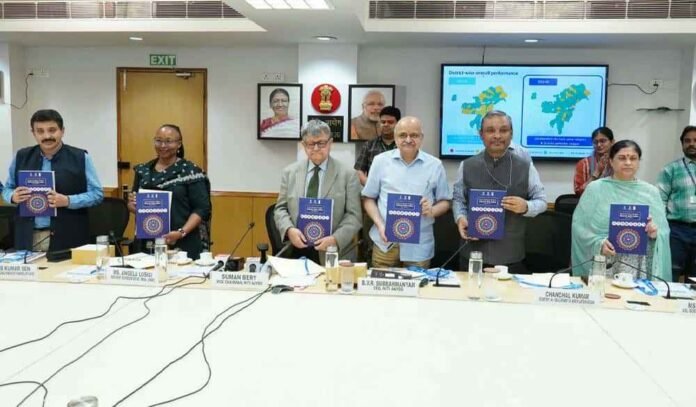
According to the latest North Eastern Region District SDG Index, jointly released by NITI Aayog, the Ministry of Development of North Eastern Region (MDoNER), and UNDP, an impressive 85% of districts in India’s Northeast have achieved ‘Front Runner’ status for 2023–24—up from 62% in the previous edition.
Top-Performing Districts: Hnahthial & Champhai Lead
Leading the region is Hnahthial district in Mizoram, with a score of 81.4, closely followed by Champhai, which secured 79.8. These two districts exemplify excellence in social, economic, and environmental SDG indicators.
Uniform Excellence Across Mizoram, Sikkim & Tripura
All districts in Mizoram, Sikkim, and Tripura have been classified as Front Runners—scoring between 65 and 99—demonstrating strong regional parity and consistent development outcomes.
Regional Standouts and Lagging Areas
-
Sikkim emerged as the most balanced state, with just a 5.5-point gap between its highest and lowest district scores.
-
Tripura followed with a 6.5-point variation, reflecting stable district-wise performance.
-
Nagaland and Mizoram showed larger intra-state disparities, with score gaps of 15.07 and 13.72, respectively.
-
Other high-scoring districts included Gomati (Tripura), Mokokchung (Nagaland), Gangtok (Sikkim), and Dibrugarh (Assam).
-
Longding in Arunachal Pradesh was the lowest-ranking district in the region, with a score of 58.71.
Sectoral Gains: Hunger and Health Lead the Way
Five states—Assam, Meghalaya, Mizoram, Sikkim, and Tripura—recorded notable improvements in SDG 2 (Zero Hunger) and SDG 3 (Good Health and Well-being). A total of 93 districts showed enhanced performance on these two indicators, reflecting stronger healthcare outreach and nutritional outcomes.
What the Numbers Mean
The SDG Index evaluates districts across 84 indicators mapped to the 17 Sustainable Development Goals, assigning them to four performance categories:
-
Aspirant (0–49)
-
Performer (50–64.9)
-
Front Runner (65–99)
-
Achiever (100)
Notably, no district achieved a perfect score or remained in the Aspirant category, a positive indication of overall improvement in the region.
NITI Aayog has credited the momentum to the Aspirational Districts Programme, improved local governance, and better integration of flagship schemes at the district level.
Policy Implications and Forward Outlook
This performance serves as a critical tool for data-driven planning, enabling state and district administrations to prioritize resources and interventions. The Northeast’s achievements demonstrate the value of granular tracking and local accountability, especially in delivering social services and improving human development indicators.
As India looks toward meeting its 2030 SDG commitments, the Northeast’s example underscores the potential of regional models and focused governance in accelerating sustainable and inclusive development.