

Paromita Das
GG News Bureau
New Delhi, 6th Jan. The Aam Aadmi Party (AAP), led by its national convenor Arvind Kejriwal, has built its political narrative on promises of governance reforms and welfare schemes. Yet, the party now finds itself mired in controversy as women from Punjab and Delhi accuse it of making hollow pledges. Protests erupted outside Kejriwal’s residence in Delhi, with women alleging betrayal over unfulfilled promises of monetary support. These claims come just weeks after the announcement of a new welfare scheme in Delhi, which has since been questioned for its authenticity. With assembly elections in Delhi on the horizon, the controversy over these promises is intensifying, exposing cracks in AAP’s populist image.
The Women’s Protests: A Cry of Betrayal
On Saturday, a group of women from Punjab staged a protest outside Kejriwal’s Delhi residence. Chanting slogans and carrying banners, they accused the AAP-led Punjab government of reneging on its promise to provide Rs 1,000 to every woman, a pledge that played a crucial role in the party’s electoral success in the state.
“We have come from Punjab’s Gurdaspur. People there are poor. They promised to give Rs 1,000 to every woman, but it was a lie,” one protestor told reporters. Another woman added, “Do not cheat the women of Delhi as you did with the women of Punjab.” These protests highlight the growing discontent among voters who feel deceived by AAP’s lofty promises.
#WATCH | A group of women from Punjab hold a protest outside the residence of AAP national convenor Arvind Kejriwal's residence in Delhi claiming that the promises made by him during the Punjab assembly elections are not yet fulfilled. pic.twitter.com/cbijy5XNv1
— ANI (@ANI) January 4, 2025
The Delhi police detained several women during the protest, but their grievances had already gained significant public attention. The protests underscore the disconnect between the AAP’s campaign rhetoric and its governance reality, particularly concerning welfare schemes targeting women.
The Mukhyamantri Mahila Samman Yojana: A Questionable Announcement
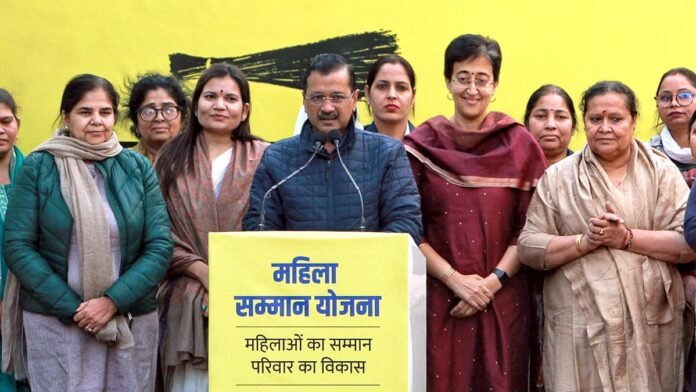
Adding to the controversy, Kejriwal announced the ‘Mukhyamantri Mahila Samman Yojana’ on December 22, pledging Rs 2,100 per month to women in Delhi. However, the announcement quickly faced scrutiny. The Women and Child Development (WCD) department of the Delhi government clarified that no such scheme had been officially notified. This led to widespread confusion and raised questions about the party’s intentions.
Delhi Chief Minister Atishi attempted to shift the blame, alleging that BJP had pressured officials into issuing misleading notifications. She claimed, “These notifications are false. We will take action against officials responsible for issuing them.” This defense, however, failed to address the broader concerns about the legitimacy of the announcement and its timing, just weeks before the expected assembly elections.
Further complicating matters, Delhi Lieutenant Governor Vinai Kumar Saxena launched an inquiry into allegations that unauthorized individuals were collecting personal data from residents under the guise of registering them for the scheme. This raised fears of misuse of voter data and added a layer of mistrust to the entire episode.
Punjab’s Broken Promise: Rs 1,000 for Every Woman
The controversy in Delhi mirrors similar issues in Punjab, where AAP had promised to provide Rs 1,000 to every woman as part of its election campaign. This promise was instrumental in the party’s sweeping victory in the Punjab assembly elections, with Bhagwant Mann becoming the Chief Minister. However, the pledge remains unfulfilled, with no clear timeline or explanation from the state government.
The failure to implement the scheme has sparked widespread criticism from opposition parties and civil society groups. Women in Punjab, particularly those from economically weaker sections, feel abandoned and betrayed. The protests in Delhi highlight how this unfulfilled promise is haunting AAP beyond state boundaries, eroding its credibility among key voter groups.
Election Dynamics: Promises as Political Tools
With the Delhi assembly elections likely in February 2025, AAP’s promises have taken center stage. The party, which won 62 out of 70 seats in the 2020 elections, faces a fragmented opposition, with Congress struggling to regain relevance and BJP seeking to make inroads. Against this backdrop, Kejriwal’s announcement of the Mukhyamantri Mahila Samman Yojana appears strategically timed to consolidate voter support, especially among women.
However, the backlash over unfulfilled promises in Punjab and the questionable authenticity of the Delhi scheme threaten to undermine this strategy. The controversy raises concerns about the use of welfare promises as electoral bait rather than genuine policy initiatives.
Populism Without Accountability
Arvind Kejriwal’s political journey has been marked by a reliance on populist promises to gain voter trust. While welfare schemes like free electricity, water, and education subsidies have resonated with voters, the recent controversies expose a troubling pattern of overpromising and underdelivering.
The unfulfilled Rs 1,000 pledge in Punjab and the ambiguous Rs 2,100 promise in Delhi suggest that AAP may be prioritizing electoral gains over sustainable governance. Such tactics risk alienating the very voters the party claims to champion, particularly women and economically vulnerable groups.
Moreover, the lack of transparency surrounding these schemes raises serious ethical questions. Announcing welfare programs without proper budgeting, planning, or official notification not only undermines public trust but also risks damaging the integrity of the electoral process.
Conclusion: The Cost of Broken Promises
As AAP faces mounting criticism over its welfare promises, the protests by women from Punjab serve as a stark reminder of the real-world consequences of political gimmicks. For a party that built its identity on honesty and governance reforms, these controversies mark a significant setback.
The upcoming Delhi assembly elections will be a litmus test for AAP’s credibility. If the party fails to address the grievances of its voters and deliver on its promises, it risks losing the trust that propelled it to power in multiple states. In the long run, sustainable governance, backed by accountability and transparency, will determine whether AAP can maintain its position as a force for change or if it will become yet another example of populism gone awry.
The protests outside Kejriwal’s residence symbolize the growing disillusionment with politics that prioritizes promises over people. As India’s political landscape evolves, voters will increasingly demand accountability, making it imperative for parties like AAP to match their words with actions. For now, the ball is in Kejriwal’s court, and the stakes couldn’t be higher.
The post Promises or Political Ploys? Kejriwal Faces Backlash Over Unfulfilled Cash Schemes for Women in Delhi and Punjab appeared first on Global Governance News- Asia's First Bilingual News portal for Global News and Updates.