

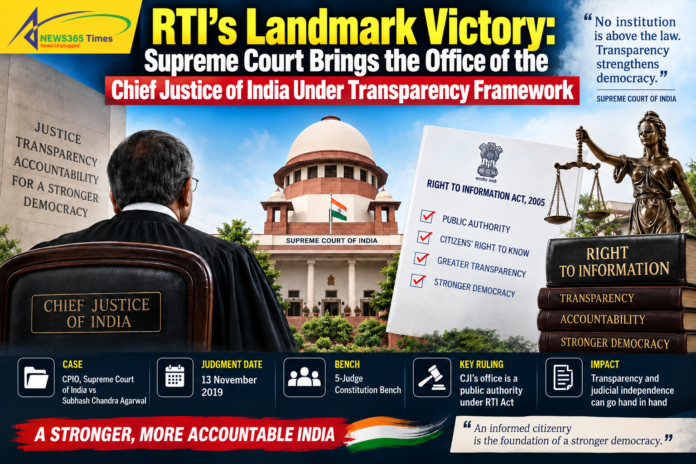
New Delhi: In what is widely regarded as a landmark moment in India’s transparency and accountability framework, the Supreme Court of India, in its historic judgment delivered on November 13, 2019, held that the Office of the Chief Justice of India (CJI) falls within the definition of a “public authority” under the Right to Information (RTI) Act, 2005.
The judgment came in the case CPIO, Supreme Court of India vs Subhash Chandra Agarwal, arising from a long-running battle over access to information concerning the functioning of the highest judicial institution in the country.
A five-judge Constitution Bench delivered the verdict, upholding the principle that transparency and judicial independence must be balanced and that accountability is an essential component of a constitutional democracy.
The RTI Question That Reached the Supreme Court
The legal battle began after RTI activist Subhash Chandra Agarwal sought information relating to whether judges of the Supreme Court had submitted declarations of their assets to the Chief Justice of India.
The matter travelled through the information commission and the courts, eventually reaching the Supreme Court. A key question before the Constitution Bench was whether the office of the CJI could be treated as a public authority under the RTI Act.
In its landmark ruling, the Supreme Court held that the Office of the Chief Justice of India is a public authority under Section 2(h) of the RTI Act.
Transparency and Judicial Independence
The judgment also examined the relationship between transparency, privacy, confidentiality and judicial independence. The Court emphasised that the right to information is not absolute and must be balanced against legitimate concerns such as privacy and other statutory exemptions.
However, the recognition of the CJI’s office as a public authority was seen as a significant affirmation of the principle that constitutional institutions are also subject to transparency requirements under the law.
The decision established that the judiciary’s independence and the public’s right to information are not necessarily opposing principles and must be harmonised on a case-by-case basis.
A Major Milestone in India’s RTI Movement
The case became one of the most significant judgments in the history of the RTI movement because it involved the applicability of the transparency law to the administrative functioning of the office of the country’s top judicial authority.
RTI activists and transparency campaigners have described the ruling as an important milestone in strengthening public accountability.
The judgment reinforced the broader principle that no public institution is automatically beyond the scope of statutory transparency obligations merely because of its constitutional importance or institutional status.
At the same time, the Court made it clear that disclosure of information would still be subject to the exemptions and safeguards provided under the RTI Act, including considerations relating to privacy, confidentiality and the independence of the judiciary.
Legacy of the Subhash Chandra Agarwal Case
The CPIO, Supreme Court of India vs Subhash Chandra Agarwal case remains a defining chapter in India’s Right to Information movement. The ruling is frequently cited in discussions concerning institutional accountability, judicial transparency and citizens’ right to seek information from public authorities.
For RTI applicants, the judgment serves as an important legal precedent supporting the principle of transparency while also recognising that every request for information must be examined according to the provisions and exemptions contained in the RTI Act.
The 2019 Constitution Bench verdict continues to stand as a powerful reminder that transparency, accountability and the rule of law are fundamental pillars of democratic governance.