

Paromita Das
GG News Bureau
New Delhi, 1st Feb. The newly-inaugurated Trump administration in the United States has implemented a stringent approach towards illegal immigration, intensifying border security, expediting deportations, and enforcing border laws with unprecedented rigor. These measures have drawn global attention, particularly in countries like Bharat, where large numbers of illegal immigrants from neighboring nations, such as Bangladesh and Myanmar, continue to reside. As the US steps up its efforts to identify, detain, and deport illegal immigrants, questions have arisen about why Bharat does not adopt similar aggressive methods. Specifically, many have pointed to the issue of Rohingya and Bangladeshi immigrants, with estimates suggesting a large population residing in Bharat. In contrast to the US, Bharat faces unique political, diplomatic, and logistical challenges that complicate its efforts to address illegal immigration.
The Rohingya and Bangladeshi Immigrant Situation in Bharat
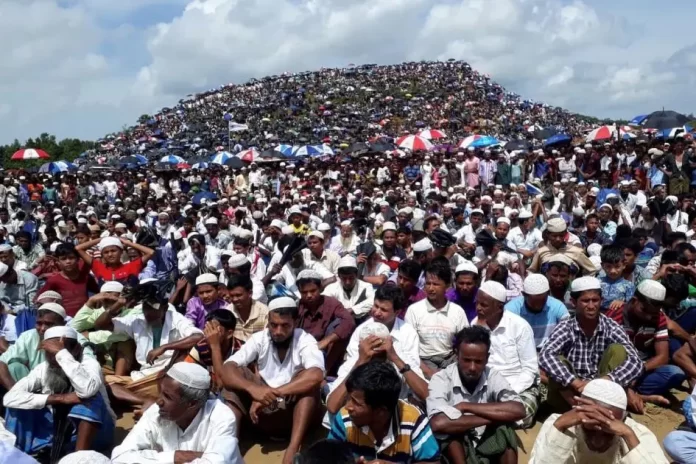
According to estimates from the Ministry of Home Affairs, over 40,000 Rohingya immigrants fled to Bharat, escaping persecution in Myanmar. Of these, only about 16,000 are registered with the United Nations High Commissioner for Refugees (UNHCR). The influx of Bangladeshi immigrants, meanwhile, has been a much more contentious issue. In 2016, Union Minister Kiren Rijiju reported that over 2 crore illegal Bangladeshi immigrants reside in Bharat, though earlier estimates, including one from 2001, suggested a lower but still significant number. While exact numbers remain hard to verify, the presence of these illegal immigrants in Bharat has become a sensitive political topic.
The US Approach vs Bharat’s Challenges in Deportation
The Trump administration’s commitment to deporting illegal immigrants has led to mass raids and a more efficient system for identifying and sending immigrants back to their home countries. In contrast, Bharat faces a more complex situation. For one, many Rohingyas are stateless, as Myanmar’s 1982 Citizenship Law does not recognize them as citizens. The lack of a country to which these immigrants can be sent back creates a diplomatic and legal conundrum. While Bangladesh acknowledges its own nationals in Bharat, it has been reluctant to take back illegal immigrants without clear proof of citizenship. Additionally, resistance from political parties in Bharat, particularly those relying on Muslim vote banks, adds another layer of complexity to the issue.
Security Concerns and the Role of Statelessness
Rohingya refugee camps have increasingly been associated with security risks, including radicalization and involvement in criminal activities such as human trafficking. Some authorities have raised alarms over the possible Islamicization of Hindu-majority regions, particularly Jammu, through the settlement of Rohingyas. Despite these concerns, Bharat’s approach to deporting these immigrants has been hindered by the complex issue of their statelessness. Without a country to send them back to, and under international laws prohibiting the deportation of individuals to places where they might face persecution, Bharat finds itself in a precarious situation.
The Resistance to Border Security Measures in Bharat
While the Bharatiya government has taken measures to address illegal immigration through enhanced border security and attempts to build fences along porous borders, resistance from state governments and local political groups continues to impede progress. In states like West Bengal and Mizoram, land acquisition for border fencing has been delayed, and in some cases, local groups have actively opposed these efforts. This resistance, often rooted in political considerations, is particularly focused on regions with high concentrations of illegal immigrants, many of whom are Muslim. The resistance to border fencing has allowed illegal immigration to continue unchecked, exacerbating the challenges of deportation.
Diplomatic Strains and Bangladesh’s Role
The issue of illegal Bangladeshi immigrants remains contentious, especially given that Bangladesh does not acknowledge the presence of its nationals in Bharat. Bangladesh has historically been unwilling to accept its citizens back without clear proof of nationality, and this has been a significant barrier to deportations. Additionally, tensions between Bharat and Bangladesh over border security measures, such as the installation of fencing, have further complicated the situation. Bangladesh opposes the construction of fences along its border with Bharat, citing the 1975 Joint Bharat-Bangladesh Guidelines. However, Bharat argues that these fences are essential for national security and do not violate the agreement.
The comparison between the US’s aggressive approach to illegal immigration and Bharat’s more nuanced strategy highlights the stark differences in the two countries’ immigration challenges. While the US has the advantage of being able to deport illegal immigrants to their home countries, Bharat faces the dual challenge of statelessness and diplomatic resistance. Moreover, political considerations, particularly related to Muslim vote banks, have hindered the effective enforcement of deportation policies. This complex web of legal, political, and diplomatic challenges has created a situation in which Bharat is unable to follow the US’s lead in deporting illegal immigrants.
Conclusion
Bharat’s struggle to address the issue of illegal immigration, particularly from Myanmar and Bangladesh, is a multifaceted problem that cannot be solved by simply emulating the US approach. While the US has taken a firm stance on deportation and border security, Bharat must navigate a more complicated legal and political landscape. The presence of stateless Rohingyas, the resistance from Bangladesh, and the political ramifications of deporting illegal immigrants make the task particularly challenging. Until these issues are addressed, it seems unlikely that Bharat will be able to adopt the same aggressive measures seen in the United States. As the debate continues, it is clear that Bharat will need a more comprehensive and multi-dimensional approach to tackle the illegal immigration issue effectively.
The post The Complex Debate: Why Bharat’s Deportation Efforts Fall Short Compared to the US Approach appeared first on Global Governance News- Asia's First Bilingual News portal for Global News and Updates.