

Paromita Das
GG News Bureau
New Delhi, 3rd December- The Delhi borders are once again a flashpoint as farmers from Uttar Pradesh gather to press for their demands under the new agricultural laws. The farmers’ “Delhi Chalo” march, led by Bhartiya Kisan Parishad (BKP) leader Sukhbir Khalifa, has caused significant disruptions in the Delhi-Noida region. With thousands of protesters descending upon the area and blocking major routes, the issue has rekindled debates about the effectiveness of the government’s approach to resolving agrarian concerns.
The Farmers’ Demands: A Cry for Justice
The core demands of the farmers highlight their dissatisfaction with the implementation of agricultural policies. These include increased land compensation, better rehabilitation measures, and the withdrawal of legal cases against protesters from previous agitations. Their grievances point to deeper systemic issues within the framework of land acquisition and agricultural reforms.
One of the most pressing demands is for enhanced land compensation. Farmers are advocating for a 64.7% increase in compensation under the revised land acquisition law, arguing that the current rates fail to reflect the true value of their land. Additionally, they seek a 10% allocation of plots from acquired land, ensuring that the displaced are not left without a means to rebuild their lives.
The call for employment and rehabilitation benefits further underscores the plight of landless farmers whose livelihoods are at risk. By demanding jobs for their children, they aim to secure a more stable future for their families. Their insistence on implementing directives from the High Power Committee on agricultural policies highlights a lack of trust in the government’s promises.
The Protests: A Recurring Nightmare for the Capital
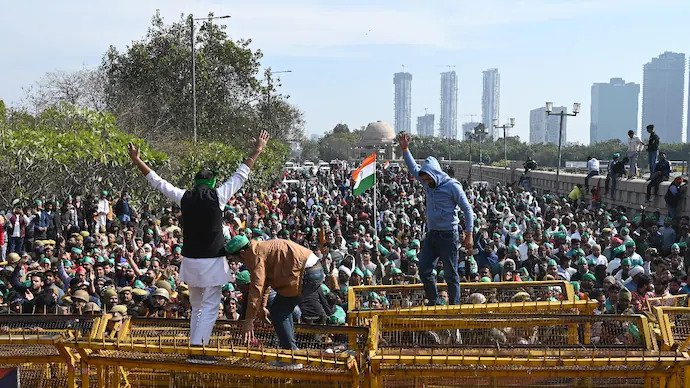
The protests have brought parts of Delhi-NCR to a standstill. Despite heavy security measures, farmers broke through barricades and blocked major highways, causing massive traffic jams. The DND Flyway and Chilla Border witnessed gridlock, leaving commuters stranded for hours. Police efforts to manage the situation included route diversions and intensive vehicle checks, but the scale of the protest overwhelmed the infrastructure.
The visuals of farmers sitting on roads and breaking barricades evoke memories of the 2020-2021 protests. These earlier demonstrations lasted for over a year, resulting in significant economic losses and disruptions to daily life. The government’s inability to prevent a recurrence has raised questions about its preparedness and commitment to addressing farmers’ concerns.
किसान दिल्ली की ओर बढ़ रहे हैं pic.twitter.com/zk8F6qI6Y1
— Ranvijay Singh (@ranvijaylive) December 2, 2024
Government’s Response: Security vs. Dialogue
The government’s immediate response has focused on security. A three-layered barricading system, involving over 4,000 police personnel in riot gear, has been deployed to prevent protesters from entering the capital. While this demonstrates a determination to maintain law and order, it also highlights the lack of a long-term solution.
The detention of farmer leaders and the closure of key roads reflect an adversarial approach that risks escalating tensions. Critics argue that the focus should instead be on dialogue and addressing the root causes of the unrest. The prolonged nature of past protests serves as a cautionary tale, emphasizing the need for proactive engagement rather than reactive containment.
The Larger Implications: Economy and Public Sentiment
The economic implications of such protests cannot be ignored. The disruptions caused by road blockages and route diversions impact commerce and daily activities in the national capital region, one of Bharat’s economic hubs. The 2020 protests cost billions in lost productivity, and a similar trajectory could severely hinder post-pandemic recovery efforts.
Moreover, the protests are a reflection of the growing disconnect between the government and rural communities. The farmers’ demands, particularly regarding land acquisition and employment, resonate with a broader audience concerned about equitable development. Failure to address these issues could erode public trust and exacerbate social divides.
Striking a Balance
The recurrence of farmer protests is a clear signal that the government must revisit its approach to agrarian policies. While security measures are necessary to maintain public order, they should not overshadow the importance of dialogue and compromise. The farmers’ demands, rooted in their lived experiences, deserve a fair hearing and actionable responses.
The solution lies in creating a framework that balances developmental goals with the rights of those affected by land acquisition. Policies must ensure that compensation and rehabilitation measures are not only adequate but also implemented transparently. By addressing these concerns, the government can mitigate the risk of future protests and build a more inclusive development model.
Conclusion: A Crossroads for Bharat’s Agricultural Policy
The ongoing protests at the Delhi-Noida borders are a stark reminder of the challenges Bharat faces in reconciling development with social equity. The government’s handling of the situation will set a precedent for its approach to agrarian issues in the future. By prioritizing meaningful dialogue and addressing the legitimate concerns of farmers, the administration has an opportunity to transform a crisis into a catalyst for reform.
The stakes are high—not just for the farmers but for the nation as a whole. Resolving the protests in a manner that respects the rights of all stakeholders will be a testament to Bharat’s commitment to democratic values and sustainable development
The post The Resurgence of Farmer Protests: A Crisis at Delhi-Noida Borders appeared first on Global Governance News- Asia's First Bilingual News portal for Global News and Updates.