

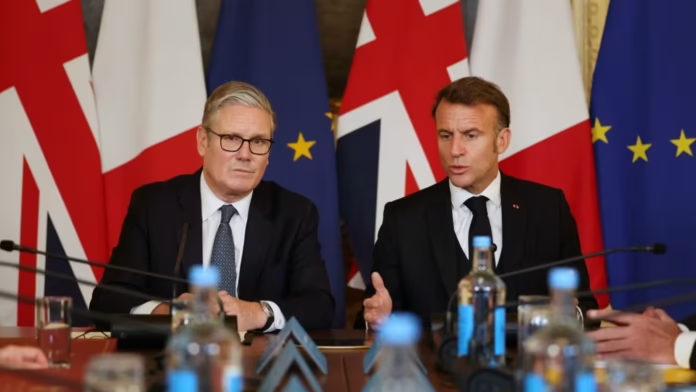
The United Kingdom and France have formalized a new bilateral migration agreement known as the “one‑in, one‑out” pilot scheme. Announced during French President Emmanuel Macron’s state visit to the UK, this deal allows Britain to return migrants arriving by small boats to France while permitting an equal number of pre‑approved asylum seekers from France with UK-based familial ties to enter the UK. The pilot is expected to begin within weeks and initially process up to 50 migrants each way per week.
Simultaneously, the leaders reaffirmed their joint leadership in establishing a future multilateral Ukraine peacekeeping or stabilization coalition. They revealed plans for a Paris-based operational headquarters with rotational coordination from London, aimed at providing security assurances following any ceasefire or peace settlement in Ukraine.
Migration Deal: Strategy and Criticism
The “one‑in, one‑out” migration scheme is designed to deter dangerous channel crossings by criminal networks. France has amended maritime laws to authorize policing operations at sea to suppress unauthorized launches. Although intended as a deterrent, critics argue that returning only 50 migrants per week is symbolic compared to over 20,000 crossings in 2025. Refugee rights groups have warned about potential human rights implications and called for expanded legal routes instead of isolated bilateral returns.
Deepening UK‑France Defence Cooperation
As part of broader bilateral engagement, the UK and France signed defense cooperation agreements including coordination of their independent nuclear deterrents, expanded joint expeditionary force capability, and plans to co‑develop advanced systems like cruise missiles and anti‑drone technology. The defense commitments showcase renewed European strategic alignment.
Ukraine Coalition: Emerging Peace Architecture
Prime Minister Keir Starmer and President Macron unveiled plans to spearhead a “coalition of the willing” to support Ukraine’s stability post‑peace deal. This coalition, including around 30 to 37 nations from Europe, the Commonwealth, and beyond, is poised to provide a future stabilization or reassurance force. Its proposed tasks include securing Ukrainian airspace and seas, delivering logistical and training support, and deterring renewed Russian aggression.
The coalition concept was first proposed at the London Summit in March and has moved into an operational planning phase. While troop commitments remain undeclared, the coalition is described as flexible—some countries may contribute forces, others may offer financial, logistical or political support.
Challenges and International Reactions
Not all nations are ready to participate actively. Some European governments have expressed support for the concept but have stopped short of committing troops. Others caution that deployment of troops on Ukrainian territory could be premature or politically sensitive. Russia has strongly condemned the idea, arguing any Western military presence amounts to direct confrontation. Meanwhile, proponents emphasize the necessity of European-led security guarantees as the United States progressively reduces its direct role.
Significance of the Agreements
-
Migration policy: The pilot return scheme marks the most concrete UK‑France coordination on migration since Brexit. Although modest in scale, it represents renewed ties and shared mechanism-building.
-
Ukraine strategy: The coalition initiative reflects a shift in European responsibility for security. The UK and France are positioning themselves as the drivers of a continental effort to back a post-conflict reconstruction and defense arrangement.
-
Strategic autonomy: These agreements reflect Europe’s broader ambition to assume greater agency in shaping its security environment amid growing uncertainty from transatlantic realignment.
The UK-France summit delivered two major commitments: a pilot migration scheme and leadership of a nascent Ukraine peace coalition. The migration deal seeks to offer deterrence while adhering to human rights safeguards, though its limited scale invites scrutiny. More consequential may be the emerging European-led stabilization architecture for Ukraine—an important signal of continental cohesion in the face of Russian aggression. Together, these developments mark a new era of Franco-British influence in migration management and geopolitical security.