

Paromita Das
GG News Bureau
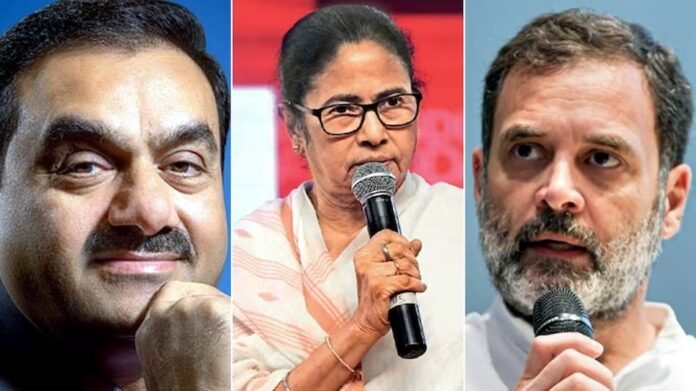
New Delhi, 7th December- What started as a rhetorical offensive by the Congress party, spearheaded by Rahul and Priyanka Gandhi, against the Adani Group has turned into a glaringly isolated campaign, with prominent allies like the Trinamool Congress (TMC) and Samajwadi Party (SP) opting out of the anti-Adani crusade.
In the latest protests, Congress MPs donned jackets emblazoned with slogans such as “Modi Adani Ek Hai, Adani Safe Hai”—a stark symbol of their continued tirade. However, these tactics raise critical questions about the intent, credibility, and strategic foresight of the Congress-led campaign, especially as it seems increasingly disconnected from its allies and broader national priorities.
Cracks in the I.N.D.I. Alliance
The opposition alliance, touted as a collective force against the ruling Bharatiya Janata Party (BJP), has shown clear signs of disunity in the face of the Adani controversy. The decision of parties like the TMC and SP to refrain from endorsing Congress’s anti-Adani rhetoric highlights the growing tensions within the bloc. This divergence underscores the individual political calculations of regional parties, which often prioritize their electoral and regional narratives over the alliance’s collective agenda.
TMC MP Kirti Azad’s comment, “We have other issues to highlight,” encapsulates the sentiment of many within the opposition.
TMC skips I.N.D.I.A bloc's protest against Adani.
Make Mamata Banerjee the leader of I.N.D.I.A bloc: TMC MP Kirti Azad speaks to @pragyakaushika@RishabhMPratap with more inputs on the story. pic.twitter.com/xHEWITCwQI
— TIMES NOW (@TimesNow) December 3, 2024
For these parties, aligning with Congress on the Adani issue seems more like a liability than an opportunity. The move reveals a strategic divergence, with regional players focusing on pressing local issues rather than wading into what they perceive as Congress’s manufactured outrage.
Congress’s Selective Outrage and Its Political Hypocrisy
The Congress party’s accusations against the Adani Group—centered around alleged bribery of Bharatiya government officials between 2020 and 2024—warrant a thorough investigation. Yet, the party’s selective outrage exposes glaring contradictions. For instance, Congress has turned a blind eye to similar dealings involving non-NDA states such as Odisha, Tamil Nadu, Andhra Pradesh, and Chhattisgarh, many of which are governed by I.N.D.I. alliance members. This duality severely undermines the credibility of its narrative.
Moreover, the Congress-led protests reveal a striking level of political opportunism. By focusing solely on Adani, the party risks overshadowing critical issues such as illegal immigration, the unchecked powers of Waqf Boards, and economic reforms—topics that resonate more with the general electorate. This selective prioritization, viewed by some as pandering to populist sentiments, diminishes the broader opposition’s ability to mount a coherent challenge to the BJP.
Adani and the Politics of Sensationalism
The Congress’s campaign against the Adani Group exemplifies a larger trend of reducing complex economic interactions to simplistic, villainous narratives. Prominent business leaders like Gautam Adani are integral to Bharat’s economic growth and global influence. Countries worldwide rely on their businesses to project soft power—whether it is the U.S. through Apple and McDonald’s or South Korea through Samsung.
Bharat’s burgeoning status on the global stage is inseparable from the success of its businesses, including the Adani Group. The Congress’s rhetoric, by portraying Adani as a symbol of crony capitalism, risks undermining Bharat’s image abroad. Such an approach not only harms the nation’s economic interests but also weakens its diplomatic leverage, as businesses play a pivotal role in second-tier diplomacy.
Rahul Gandhi’s Isolated Stand
Rahul Gandhi’s solo march from Parliament to the streets symbolizes more than his commitment to the Adani issue—it highlights the Congress party’s growing isolation within the opposition. While the protests aimed to mobilize public sentiment, the lack of support from key allies has turned this endeavor into a largely unilateral exercise. This isolation reflects deeper fractures within the I.N.D.I. alliance, where member parties increasingly prioritize their political survival over collective unity.
The broader implications of this isolation are significant. Without the backing of major opposition parties, Congress risks alienating itself further, both within the alliance and in the larger political discourse. This lack of cohesion weakens the opposition’s ability to present a united front against the BJP in upcoming elections.
The Need for a Balanced Approach
The Adani controversy underscores the need for a balanced and transparent investigation, free from the trappings of media sensationalism and political grandstanding. Allegations of bribery must be examined through established legal mechanisms, with due respect for judicial processes. Any premature conclusions or politically motivated campaigns risk undermining the principles of justice and due process.
By framing the Adani issue as a political witch hunt, Congress diminishes its own credibility and distracts from pressing national priorities. A more measured approach—one that emphasizes evidence-based inquiry and avoids sensationalist narratives—would serve the nation far better.
Conclusion: Political Opportunism vs. National Interest
The ongoing drama over the Adani controversy reveals more about the political opportunism of Congress than it does about any earnest pursuit of accountability. In its attempt to sensationalize the issue, the party has not only alienated its allies but also risked diverting attention from critical national concerns.
For the I.N.D.I. alliance, the Adani controversy is a litmus test of its ability to navigate internal differences and present a coherent narrative. So far, the cracks within the alliance suggest a lack of consensus on priorities, undermining its effectiveness as a political force.
Ultimately, the Adani case requires a nuanced and impartial investigation—one that prioritizes accountability over theatrics and national interest over political expediency. Without such an approach, the current discourse risks devolving into mere noise, leaving critical issues unresolved and eroding public trust in the political process.
The post Unraveling the Political Saga: Adani Controversy, Congress Rhetoric, and the Fractured I.N.D.I. Alliance appeared first on Global Governance News- Asia's First Bilingual News portal for Global News and Updates.